AI Superhero Comic Generator: Locked Heroes Across Every Panel
By the TaleAtelier Editorial Team — last reviewed
TL;DR
TaleAtelier makes superhero comics with locked heroes across up to 400 panels. Powered by Nano Banana Pro (Gemini 3 Pro Image, GA November 2026). 19 art styles including Noir (for Watchmen-style grimdark) and Sci-Fi (for cosmic hero epics). Monthly plans from $9.99. Verdict: best for superhero stories. Have a photo of yourself? Turn it into a superhero comic →
The style
One sample panel — the visual language of Superhero rendered by TaleAtelier. Line weight, palette, and composition conventions all baked into the discipline.
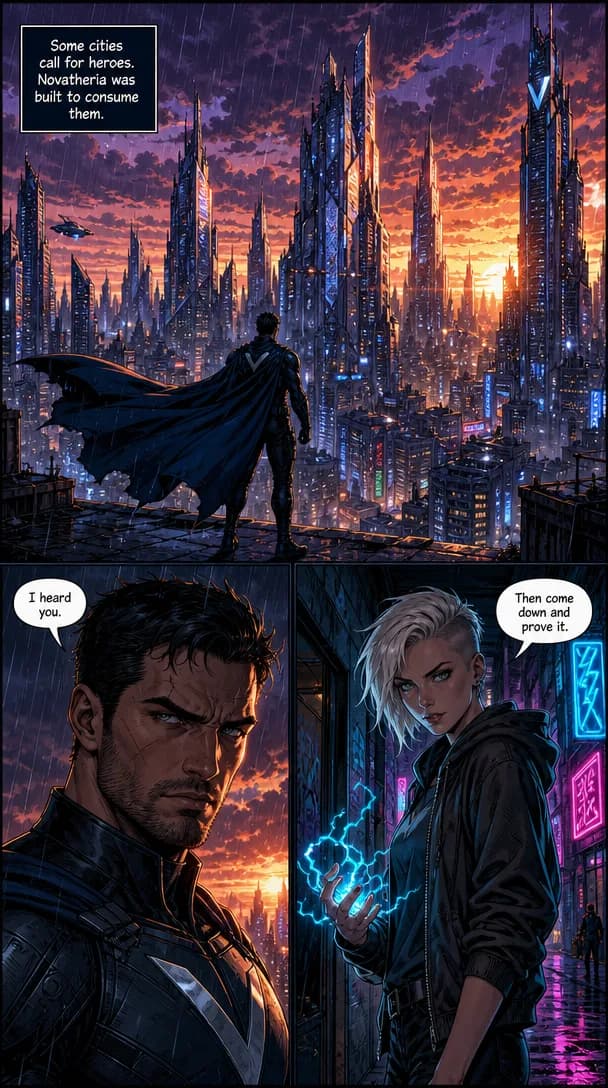
Start with our AI comic generator and pick Superhero as your discipline.
How to make a superhero comic on TaleAtelier
Five steps, ~30 minutes for a 10-panel Short comic.
- 1
Sign up (free account)
2-3 minCreate a free account. Save characters and drafts. Pick a plan when you're ready to generate — enough for a Short superhero comic origin scene.
- 2
Pick the Superhero style
1 minSuperhero on TaleAtelier is bold-ink + primary palette + action-driven composition. For grimdark superhero (Watchmen, Batman: Year One tradition), layer Noir style.
- 3
Design your hero and villain (locked)
3-5 minUpload references or describe both. Costume design is what makes a hero recognizable — TaleAtelier stores a character fingerprint (silhouette, color palette, insignia, mask/cowl shape) and reuses it across every panel. Track up to 6 characters.
- 4
Write the story arc
5-10 minPlot in 3-5 sentences per act. Superhero arcs work best on classic structure: normal life → inciting event → hero response → escalation → resolution.
- 5
Generate and refine
10-20 min for 10 panelsNano Banana Pro renders each panel with your locked heroes and Superhero visual language. Regenerate action panels that miss the pose — dynamic superhero action needs iteration.
Superhero visual conventions
Superhero comics developed a distinct visual language from newsstand economics (had to grab attention at 20 feet) and the demands of action storytelling. When you pick Superhero on TaleAtelier, we bake in:
| Convention | What it is | Origin |
|---|---|---|
| Bold ink outlines | Heavy black contour around characters and props. Reads instantly at a distance — designed for newsstand visibility. | Golden Age comics (1938+), refined by Jack Kirby |
| Primary palette | Saturated red, blue, yellow. High-contrast, minimal mid-tones. Costume colors as brand identity. | Superman (1938), Captain America (1941) |
| Dynamic action poses | Foreshortening, dramatic angles, motion emphasis. Heroes never stand still — they leap, fly, punch. | Jack Kirby's dynamic action language (Fantastic Four 1961+) |
| Costume as silhouette | A great superhero design reads as a solid black silhouette. Batman, Spider-Man, Wonder Woman all pass this test. | Bob Kane / Bill Finger's Batman (1939) silhouette principle |
| Splash panels | Single-panel full-page compositions for major reveals or hero shots. Established as a superhero-comic staple. | Silver Age (Marvel 1961-1970); Will Eisner's Spirit uses them earlier |
Reference: Scott McCloud, Understanding Comics (1993); Will Eisner, Comics and Sequential Art (1985). Verified .
Superhero eras — Golden Age to modern grimdark
Superhero visual language shifted dramatically across the four traditional ages. Match your comic's tone to the right era:
| Era | Look | Canonical works | TaleAtelier tip |
|---|---|---|---|
| Golden Age (1938-1956) | Simple bold colors, thick outlines, patriotic palette | Superman (Siegel + Shuster 1938), Captain America (Kirby + Simon 1941) | Superhero style + primary palette + minimal detail keywords |
| Silver Age (1956-1970) | Refined line work, complex colors, cosmic scale | Fantastic Four (Lee + Kirby 1961), Amazing Spider-Man (Lee + Ditko 1962) | Superhero + Jack Kirby-inspired keywords |
| Bronze Age (1970-1985) | Darker themes, more realistic anatomy, painterly influence | Uncanny X-Men (Byrne + Claremont 1977+), Daredevil (Miller 1979+) | Superhero + darker palette + realistic anatomy |
| Modern / Grim (1986+) | Deconstructed heroes, high contrast, ink-heavy, morally ambiguous | Watchmen (Moore + Gibbons 1986), Batman: Year One (Miller + Mazzucchelli 1987) | Superhero + Noir style + morally-complex keywords |
Costume & character consistency
A superhero's costume IS their identity. If Batman's cowl changes shape between panels, readers stop believing him. TaleAtelier stores costume silhouette, primary colors, insignia location, and mask/cowl shape — and re-injects them on every panel.
Silhouette + primary palette lock reliably. Chest emblem shape and subtle costume details drift more.
See the character-consistency wedge worked in full on our photo-to-comic page, where the same character across multiple panels is the demonstration.
Superhero prompt patterns that work
Origin story panel
Named character (locked) + named era influence (Kirby) + specific composition (low angle). Model has these references.
Splash panel hero shot
Splash panels are a superhero signature. 'Foreshortened toward camera' is the key composition instruction.
Grimdark modern panel (Watchmen lineage)
Named modern-era influence (Watchmen) + noir tag + desaturated palette flips the same character into grimdark register.
When to reach for another tool (honest)
- Photo-to-hero (upload your face, get a superhero version) → Reface AI, Media.io, or Aragon. Purpose-built for one-shot photo transformation.
- Single hero portrait or character concept sheet → Midjourney V8.1 is the best-in-class for single hero portraits.
- Superhero comic story with returning heroes and villains → TaleAtelier. Multi-panel + costume consistency is exactly this use case.
FAQ
Last reviewed:
Is TaleAtelier a superhero comic generator or a photo-to-hero filter?+
Comic generator. Most search results for 'ai superhero generator' are photo-to-hero filters (upload a selfie, get a superhero portrait). We're not that. TaleAtelier is for making superhero comic *stories* with locked heroes across multiple panels. For a one-off photo-to-hero portrait, use Reface AI, Aragon, or Media.io — they're purpose-built for that job.
Can TaleAtelier keep the same hero costume consistent across every panel?+
Yes. Character fingerprints store costume silhouette, color palette, insignia, mask/cowl shape, and pass them to Nano Banana Pro on every panel generation. Costume stays consistent across 20+ panels. Small insignia details (specific chest emblem shape) drift more than the overall silhouette.
How do I get Watchmen or Batman: Year One-style grimdark superhero?+
Pick Superhero style but add Noir keywords: ink-heavy shadows, desaturated palette, morally ambiguous framing. Name the influence explicitly (Watchmen, Batman: Year One, Frank Miller, Dave Gibbons). Nano Banana Pro has these references in training. Alternative: pick Noir style + describe heroes as your subject.
Can I make my own version of Marvel or DC characters?+
Legally: no. Marvel and DC own their characters — copyright + trademark. Fan art in private is a gray area; publishing or selling is not. TaleAtelier generates whatever you prompt, so *technically* you can prompt a Spider-Man-style character, but you should create original heroes for anything published. See our terms.
What AI model powers superhero generation?+
Nano Banana Pro — Gemini 3 Pro Image (GA November 2026). It handles bold ink outlines and primary-palette rendering well. Dynamic action poses are the hardest category — regenerate 2-3 times for a punch, kick, or leap panel to get the pose you want.
How many superhero panels does each plan include?+
Starter ($9.99/mo, 2,000 coins) covers ~2-3 Short comics per month. Plus ($24.99/mo, 7,000 coins) suits regular publishing. Pro ($59.99/mo, 20,000 coins) is for studios and heavy users. All plans use the same character consistency.
Superhero style vs comic-book style — same thing?+
Overlapping but not identical. 'Comic book style' is a broader visual tradition covering superhero, Western indie (Love and Rockets), and mainstream art comics. 'Superhero style' specifically means bold ink + primary palette + dynamic action + costume. If your comic isn't about heroes, pick a broader style — Fantasy, Sci-Fi, or Noir.
Ready to make your superhero comic?
Monthly plans from $9.99. Cancel anytime.
Create your account