How to make a manga.
Making a manga is eight steps — concept, characters, script, thumbnails, pencils, inks, screentones, lettering — repeated once per page until you have a chapter. This guide walks through every step at professional depth, covers all three production paths (traditional, digital, AI-assisted), and includes a free B5 panel template you can print or fill digitally.
Written for anyone starting their first manga, whether you can draw or not. Skip to the section you need — the page is deep, but every H2 stands on its own.
Last reviewed . Format specs verified against Japanese publisher submission guidelines. Time-cost estimates cited as creator-reported per public r/mangamakers discussions — not verified platform data.
By the TaleAtelier Editorial Team
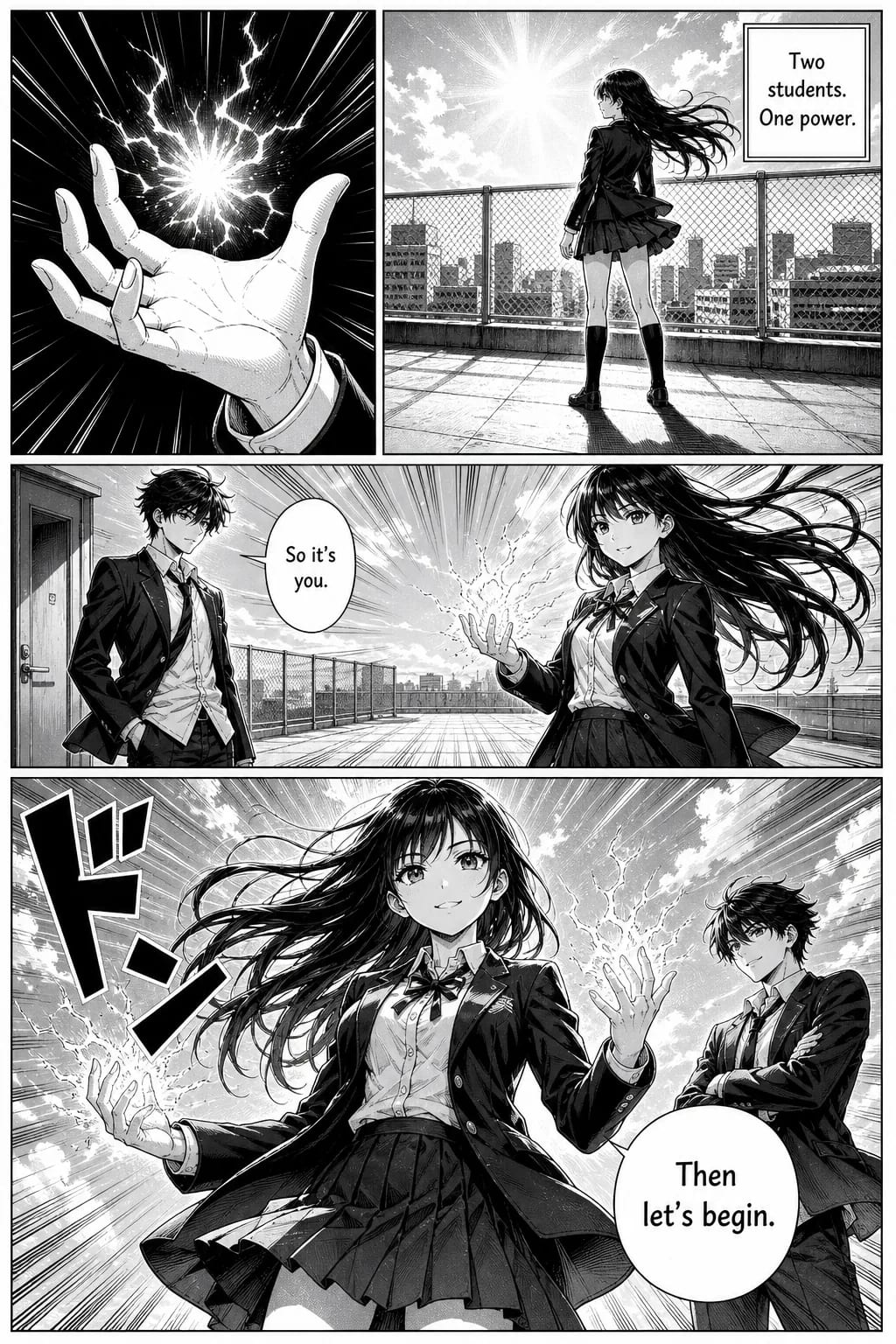
Generated with TaleAtelier. Character consistency across every panel is what separates finished manga from abandoned drafts.
Making a manga follows eight steps: concept, characters, script, thumbnail layout in RTL panel order, pencils, inks, screentones, lettering. Standard tankōbon trim is B5 (7.17 × 10.12 inches) at 350+ DPI. A chapter typically runs 18-24 pages in weekly serialization. Free downloadable panel template below plus 19 sub-sections covering every craft step.
Download a free manga panel template
Blank printable PDF at B5 trim (7.17 × 10.12 inches). Page 1: 6-panel irregular manga layout with RTL reading order, gutters, margins, and bleed marks. Page 2: clean blank skeleton with faint planning grid so you sketch your own panel divisions. Print at 100% scale. No email gate.
Download blank template (PDF)B5 tankōbon trim · 3 KB · 2-page template (example + blank skeleton)
Making a manga — 8 universal steps
These steps apply to every manga format — chapter, tankōbon, webtoon-style digital, doujinshi. Traditional pen-and-paper or fully digital, the sequence is the same. Format choice affects the details of each step, not the order.
- 01
Concept & premise
One sentence. 'Shy transfer student discovers she can see spirits.' Genre + character + hook. This becomes the anchor every subsequent decision (panel count, chapter length, tone) hangs on. Weak premise = weak manga, no matter how good your drawing.
- 02
Character design (reference sheet + silhouette-first)
Design each main character with a reference sheet (front / 3/4 / side / back views + expression grid + wardrobe). Silhouette matters more than face detail — a reader should recognize each character in pure shadow. Character consistency across chapters is what separates finished manga from abandoned drafts.
- 03
Script
Full Script format works — PAGE / PANEL headers, character names in CAPS, dialogue and captions labeled. Manga-specific tweak: number panels in RTL reading order (top-right first). Katakana SFX (バン, ドン) can be indicated with transliteration in parentheses for the artist.
- 04
Thumbnail panel layout (RTL panel order)
Sketch tiny thumbnails of every page before committing to full art. This is where panel composition, page flow, and pacing get decided cheaply. In manga, page rhythm reads top-right to bottom-left — the reader's eye lands on panel 1 (top-right) and exits at panel N (bottom-left). Test that flow at thumbnail stage.
- 05
Pencils (traditional or digital)
Traditional: light-blue col-erase pencil on B5 paper, then main pencil in graphite. Digital: Clip Studio Paint (industry standard) or Procreate on iPad. Non-destructive layers let you separate rough sketch, tighten pencils, and inks. Whichever medium, keep the working layer distinct from finished lineart.
- 06
Inks
Ink linework locks the drawing. Traditional: G-pen (soft flexible nib), Maru-pen (fine detail), brush pen. Digital: pressure-sensitive brushes emulating dip pens. Vary line weight per element — heavier outer contours, lighter interior detail. This is where the drawing becomes publication-quality.
- 07
Screentones (the manga-distinctive rendering step)
Screentones — patterned dot / line overlays used for shading, mood, and texture in black-and-white manga. Traditional: adhesive Letratone sheets. Digital: Clip Studio Paint has the deepest screentone library of any software. Screentone density signals emotion (dark = tension, light = calm). Not optional if you want manga to look like manga.
- 08
Lettering (RTL balloon flow)
Add speech balloons, narration captions, and sound effects. Manga balloons are typically oval or teardrop shaped with tails to speaker. Balloons flow top-right to bottom-left following RTL reading order. Font choice matters — manga-specific fonts (Wildwords, Manga Temple, Anime Ace) beat generic sans-serif for legibility.
Also covers: how to make a manga book, how to make your own manga, manga making process, how to plan a manga, how to make your first manga, how to make a manga series, steps to make a manga, how to make manga digital / on iPad / on computer / on paper / at home / traditionally, how to make manga without drawing, manga production process, how long does it take to make a manga, how to design a manga, how to make horror manga, manga writing tips.
Manga vs anime — the difference in one paragraph
Manga is the Japanese comic art form — printed pages, usually black-and-white with screentones, read right-to-left, published in tankōbon volumes. Anime is the animated adaptation style — moving frames, full color, cel-shaded. Many anime start as manga adaptations (Naruto, Attack on Titan, Demon Slayer, One Piece, Chainsaw Man all began as manga).
Which one are you making? Manga = sequential printed / digital pages. Anime = animation. This page covers making manga — the printed / digital page format. For animated anime, you need animation software (Toon Boom Harmony, TVPaint, Clip Studio Paint animation mode) and a fundamentally different workflow.
For the full definitional deep dive across manga, manhwa, and manhua (Korean and Chinese comic traditions), see the manga vs manhwa vs manhua guide.
Manga panel templates, page layout & book size
Standard specs used by working mangaka. Get these numbers right at the start and you avoid painful rework later.
| Format | Trim size | DPI | Notes |
|---|---|---|---|
| Tankōbon (traditional volume) | B5 · 7.17 × 10.12 in (182 × 257 mm) | 350+ | Japanese publisher standard |
| Chapter serialization | B5 · 7.17 × 10.12 in | 350 | Weekly Shonen Jump adjacent |
| US comic trim (adapted) | 6.625 × 10.25 in | 300+ | For US-audience manga publishing |
| Digital-only vertical | 800 px wide × variable height | 72 (screen) | Webtoon-style, mobile-first |
Bleed area: 0.125" (3mm) on every side. Anything past the trim line gets cut at printing. Keep critical elements 0.25" from the trim as a safety margin.
Panel count per page: typical manga page runs 4-8 panels with dramatic size variation. Splash pages (1 panel) reserved for dramatic beats. Shonen action pages tend heavier (5-8 panels); slice-of-life pages tend lighter (3-5 panels).
Panel gutters: 2-4mm between panels. Wider gutters = slower pacing / more breathing room. Tighter gutters = faster action beats. Vary within a page for rhythm.
Panel design & composition: irregular panel shapes are the manga signature — diagonal cuts, overlapping frames, panels that break the border during action beats. Don't default to uniform grids (that's Western comic convention).
Coloring manga panels: traditional manga is B&W with screentones — no color. Digital-first serialization increasingly uses full color (especially manhwa-adjacent work). If coloring: soft cel-shading, warm palette for shonen, cooler for shojo.
For AI-generated manga panels (or panel generator tools), see the AI manga generator. For broader printable comic templates covering strip, page, and graphic novel formats, see the comic book templates guide.
Also covers: manga page layout, manga page size, manga panel layout, manga page template, how to make a manga panel, manga page dimensions, manga book dimensions, manga book size, how to color manga panels, manga panel generator, manga storyboard template, manga panel maker, manga panel size, manga panel design, manga panel composition, manga panel flow, manga book template, manga panel creator, manga aspect ratio, manga margins, manga bleed, manga DPI, manga resolution.
Manga drawer — draw manga online with AI
A manga drawer is an AI tool that draws in manga style — from a text prompt, a photo, or a character description. Different from a traditional drawing tutorial that teaches humans to draw manga; an AI manga drawer generates the art itself.
How it works: pick an input (prompt, photo, or character description), pick a manga style (shonen action, shojo romance, seinen mature, chibi cute), hit generate. Output is a B&W manga panel with screentones ready to use as-is or refine further.
Manga drawer vs traditional drawing: AI manga drawers handle the visual side for creators who can't draw or want to move fast. They don't replace manga skill for creators who want the craft itself. Both paths produce publishable manga — pick per your goal (finished manga fast, or drawing skill over years).
For the dedicated AI manga tool with panel generation + character consistency across chapters, see AI manga generator. Runs in browser, no install — same account works on phone and desktop.
Also covers: manga drawer online, ai manga drawer, manga drawer ai.
How to draw manga anatomy — mouth, eyes, hair, hands
The core drawing skills that separate manga from generic illustration. Each below gets its own approach.
How to draw manga mouth
Manga mouths are often simplified to one or two clean lines — a single horizontal or slight curve for closed mouth, a small oval for open. Emotion comes from position on the face + tension in the surrounding jaw line, not detailed lip anatomy. For open mouth in dialogue, draw the tongue and lower teeth as simple shapes; skip individual teeth unless the character is shouting or emphasizing. Practice: draw the same character's mouth in 10 emotions (neutral, happy, sad, angry, surprised, disgusted, smug, embarrassed, exhausted, determined). This trains you to shift emotion through minimal linework.
How to draw manga eyes
Eyes are the emotional centerpiece of manga. Shonen eyes: sharp angular shapes, smaller irises, bold black pupils. Shojo eyes: large rounded shapes, huge irises with multiple highlight dots (sparkle effect), delicate eyelashes. Seinen eyes: realistic-adjacent, moderate size, subtle shading. Practice the same character's eyes in 5 emotions to lock consistency. Distance between eyes = roughly one eye width apart. Eye position = center of head vertically.
How to draw manga hair
Manga hair is drawn in flowing chunks, not individual strands. Break hair into 3-7 major shapes based on how it falls from the scalp. Add a few smaller stray strands for texture. Highlights are usually clean geometric zigzag shapes reflecting light source (top of head = brightest). Different characters need distinct hair silhouettes — this is the fastest identifier in manga, more than face shape. Practice: design 5 characters using only hair silhouette (no face), then confirm each stays recognizable.
How to draw manga face
Manga faces balance simplified features (small nose, minimal mouth) with expressive eyes and dramatic jaw lines. Female faces: rounder jaw, softer chin, smaller nose. Male faces: sharper jaw, more angular chin, slightly larger nose. Age indicators: children have proportionally larger heads and eyes; teens have sharper cheekbones; adults have more angular jawlines and subtle shading. The chin is often smaller than real-life proportions in shonen/shojo; realistic in seinen. Draw the same character face from front, 3/4, side to lock consistency before starting your first chapter.
How to draw manga head
Start with a circle for the cranium, add a jaw line that comes to a point at the chin. Divide the face into thirds vertically (forehead / eyes-nose / mouth-chin). Eyes sit on the center horizontal line. Ears sit between the eye line and the nose line. This grid works for front view; 3/4 view compresses the far side. Practice: draw the same head at 5 angles (front, 3/4, side, 3/4 back, back) to lock your character's shape.
How to draw manga body
Manga bodies use 6-8 head heights for adult characters (idealized proportion; realistic is 7-7.5). Children: 4-5 head heights. Chibi: 2-3 head heights. Gesture lines first — sketch the pose as a single flowing line from head through torso to legs. Anatomy on top of gesture, not before. Female bodies tend toward flowing curves; male bodies toward angular blocks. Study manga you love — sketch the body shapes without redrawing the face to isolate proportion practice.
How to draw manga hands
Hands are notoriously the hardest thing to draw. Simplify to boxes: palm = one box, four fingers = grouped shapes, thumb = separate. Get the box positions right, then refine finger detail. Reference your own hand constantly. Manga hands are often larger than realistic proportion for emphasis (holding a sword, pointing dramatically). Practice: draw the same hand in 20 positions — grip, point, wave, fist, open, holding a phone, holding a pen. Repetition beats theory here.
How to draw manga nose
Manga noses are often minimalist — a single line, a small triangle, or just a shadow beneath the eyes. Detail level scales with genre: shojo noses barely exist; seinen noses are almost realistic. From front view: the nose is often just the shadow it casts. From 3/4 view: a curved line for the bridge, a small triangle for the tip. Practice: draw the same character's nose from front, 3/4, and side to lock shape without over-detailing.
Also covers: how to draw manga bodies, how to draw manga faces, how to draw manga feet, how to draw manga expressions.
How to draw manga — general drawing guide
How to draw manga style: manga style is a set of stylistic conventions — simplified features, expressive eyes, dynamic pose framing, black-and-white with screentones, RTL panel flow. Study manga you love, then identify the specific conventions that give it its look (line weight, hair rendering, background detail level, screentone density).
How to draw manga panels: panels are borders that contain your art. Draw panels first, then compose art within them. Panel borders can be broken during dramatic moments (character breaks the frame). Diagonal panel cuts add energy; horizontal cuts add calm; vertical cuts frame single characters.
How to draw manga backgrounds: backgrounds establish setting and mood. Fully detailed backgrounds for establishing shots; simplified or screentone-only backgrounds for character-focused panels. One-point perspective for interior scenes; two-point for exteriors; three-point for dramatic angles. Save background time — most panels don't need full detail.
How to draw manga poses: gesture lines first — a single flowing line for the whole pose (head to feet), then anatomy on top. Dynamic poses use asymmetry (weight on one leg, arms at different heights). Static poses use symmetry. Reference photos of real people in the pose you're drawing — even professional mangaka reference constantly.
How to draw manga clothes: clothes follow the body underneath. Fabric folds gather at joints (elbows, knees, waist) and stretch where the body pulls the fabric (across shoulders, over knees when bent). Different fabrics have different fold patterns — silk = many soft folds, leather = few sharp folds, cotton = medium. Character wardrobe consistency across chapters matters — draw a wardrobe reference sheet.
How to draw a manga cover: covers focus on protagonist (single character, dramatic pose, dynamic angle) or ensemble (2-4 main cast). Full color for tankōbon covers even in B&W manga. Title lettering placement matters — typically top-third of the cover, character positioned in bottom two-thirds. Study popular tankōbon covers in your genre.
Beginner path: start with copying a page from your favorite manga (not to publish — just to learn). Then draw one original page per week. Consistency beats intensity — one hour daily beats 10 hours once a month.
Also covers: how to draw manga, how to draw a manga, how to draw manga anime, how to draw a manga page / panel, how to draw manga step by step, how to draw manga speech bubbles, how to draw manga scenes, how to draw manga head, how to start drawing manga, manga drawing tutorial, manga tutorial, manga drawing basics, manga drawing guide, manga drawing for beginners, steps to draw manga, best app to draw manga.
How to make a manga with AI (honest scope)
AI-assisted manga making is real in 2026. Tools generate full manga pages with panel art, dialogue placement, character consistency across chapters, screentone-adjacent B&W rendering, and RTL panel flow.
Where AI helps: writers who can't draw and want their story visually rendered fast, artists who want rough panel drafts to refine, indie creators shipping manga to social platforms, anyone testing a manga concept before committing months to hand-drawn work.
Where AI still falls short: professional publisher submissions often expect hand-drawn work (verify per publisher). Complex crowd scenes with named characters still bleed identities. Detailed screentone effects sometimes look generic. Some stylistic manga signatures (dramatic ink-slap backgrounds, specific mangaka drawing quirks) are hard to replicate cleanly.
The dedicated AI manga tool: our AI manga generator handles the pipeline — story input → panel art → dialogue → character consistency across every panel and every chapter. Runs in browser, works on mobile. For photo input specifically (turn your face into a manga character), see photo to manga. For free AI manga tool comparison, see the budget AI comic tools ranking.
Also covers: ai manga generator, ai manga, ai manga maker, manga ai generator, ai manga creator, ai manga generator free / from photo / from text / online, manga generator ai, best ai manga generator, how to make manga with ai / how to make ai manga, ai manga free / maker free / creator free, manga ai maker / creator, ai manga cover generator, ai manga page generator, ai manga website, best ai for manga / to make manga, how to create / generate manga with ai, ai manga app.
Best app for manga — software matrix
Clip Studio Paint EX — industry standard for professional manga. Deepest screentone library, panel divider tools, publisher-standard export presets, dedicated manga-page templates. From ~$9/mo or one-time purchase. Best if manga is your primary medium.
Procreate ($12.99 one-time, iPad only) — friendliest starting point. Excellent brushes, non-destructive layers, natural drawing feel. Weaker on manga-specific tooling (no built-in screentones, no panel divider) but many indie mangaka use it. Best for iPad-first workflows.
Krita — free, open-source, full-featured. Vector brush engine, layer masks, decent screentone workflow via patterns. Best free option for serious manga work. Krita for the painted panels and Inkscape for scalable speech bubbles is the Pepper & Carrot open-source pipeline.
MediBang Paint — free, mobile-first. Cloud sync across devices, community brush library, manga panel templates built in. Popular in Asia for on-phone drafting. Best for hobbyist mobile workflows.
IbisPaint X — free, mobile-only. Similar space to MediBang, brush-heavy, social features for sharing WIP. Best if you draw primarily on phone.
Photoshop — powerful but not manga-native. Some pros use it for coloring stages after inking in CSP. Not the tool to start with.
Best app pick: Clip Studio Paint EX for serious work; Procreate for iPad starters; Krita if you need free full-featured. Skip MediBang and IbisPaint unless you're specifically working mobile-first.
Also covers: manga maker / creator software, best manga drawing software, best manga making software, best manga software / for manga, clip studio paint / krita / medibang / photoshop / procreate manga tutorial, best app to make manga, manga drawing app / apps, best manga drawing app.
How to make manhua (Chinese manga)
Manhua is the Chinese comic tradition — often full color, digital-first, vertical-scroll publishing on platforms like Kuaikan, Bilibili Comics, and WeComics. Xianxia (cultivation) and wuxia (martial arts) are dominant genres, alongside modern romance and slice-of-life.
How manhua differs from Japanese manga: typically full color (not B&W), typically vertical-scroll (not page-based), typically digital-first (not print-first), reading order left-to-right (Chinese convention) rather than manga's RTL. Panel composition often follows webtoon vertical rhythm rather than manga irregular grid.
How to make manhua workflow: same 8 universal steps apply, but adjust: (a) plan for vertical-scroll composition, not page composition, (b) full-color rendering instead of screentones, (c) publishing target is Kuaikan / WeComics / Bilibili Comics or English translation sites (Manhuascan, Manhuaes) rather than tankōbon volumes.
For the manhua aesthetic deep dive see the manhua style guide. For the full definitional comparison across manga, manhwa, and manhua see the manga vs manhwa vs manhua guide.
How to write a manga (script & story)
Manga script format: same PAGE / PANEL header structure as Western comic scripts, but panel numbering follows right-to-left reading order (Panel 1 = top-right, not top-left). Sound effects often written in katakana (バン, ドン) with English transliteration in parentheses for the artist. Screentone density can be indicated in description (“light screentone background,” “heavy tone for tension”).
Manga story structure: Japanese narrative uses Kishōtenketsu — a 4-part structure (Ki introduction, Shō development, Ten twist, Ketsu conclusion) that doesn't require conflict. Story turns on recontextualization rather than escalating battle. Most slice-of-life uses it pure; most shonen blends it with Western 3-act.
For AI-structured manga plot beats using Kishōtenketsu, see the AI anime story writer (same narrative structure applies — anime and manga share Kishōtenketsu heritage).
Also covers: how to write a manga / manga, manga writer, how to write a manga script, how to write manga script, manga script example, manga script format, how to write a manga story, manga script writer, ai manga writer, how to script a manga, how to write shonen manga, manga script writer ai, manga writer ai.
Manga for beginners — where to start
Common beginner mistakes: starting with a 400-page epic (you'll burn out at page 30), skipping the script and drawing first, overdesigning the character before you can draw them consistently, comparing your first chapter to Chainsaw Man, trying to publish before finishing anything.
Fastest beginner path: write a one-shot (single self-contained chapter, 18-24 pages) rather than an ongoing series. Ship it. Then start series work with the lessons from your first finished chapter.
Also covers: manga for beginners, how to start a manga, manga tutorials, how to start making manga, ai manga tutorial, how to make a manga / manga for beginners, how to make manga step by step, how to start writing manga, manga drawing tutorial for beginners, manga making tutorial, manga tutorial for beginners.
How to publish a manga
Digital-first paths: WEBTOON Canvas (largest audience, vertical-scroll or traditional format), Tapas (similar to WEBTOON, more cross-genre), Comixology (Amazon-owned digital comic retail), Global Comix, Manga Plus (official Shueisha platform for licensed work). Digital-first is the recommended starting path — near-zero cost, immediate feedback loop.
Print self-publishing: Kindle Direct Publishing paperback (POD, no upfront cost), Blurb (higher print quality, POD), IngramSpark (wider bookstore distribution), Kickstarter (crowd-funded print run for indie tankōbon). Print your first tankōbon volume when you have 5-10 chapters done.
Traditional Japanese publisher pitch: submit to Shueisha (Weekly Shonen Jump), Kodansha (Weekly Shonen Magazine), Kadokawa, Square Enix. Requires physical submission to Japanese editorial offices; most publishers accept international submissions but require Japanese-language work or licensing partner. Long path, low acceptance rate, but the traditional gold standard.
Indie / translated manga publishers: Vertical Comics, Denpa Books, Fantagraphics (rare manga lists), Seven Seas, Yen Press occasionally sign non-Japanese original manga alongside translation work. Pitch with a full first chapter + series outline.
For WEBTOON-specific publishing (Canvas + Originals + Ad Revenue Program), see the webtoon creator career guide.
Also covers: how to publish a manga / manga, manga self publishing, how to get manga published, how to sell manga, how to self publish manga, how to publish manga on webtoon, manga print size, manga publishing platforms, how to sell manga online.
Manga storyboard — the planning step
A manga storyboard (called name ネーム in Japanese) is a rough panel layout with stick-figure characters and dialogue placement — the step between script and full pencils. This is where composition and page flow get finalized before you invest hours in detailed art.
How to storyboard a manga: on a small piece of paper (roughly 1/4 the size of your final page), sketch panel borders, rough character positions, and dialogue balloons. Spend 5-15 minutes per page. If a page doesn't work compositionally at storyboard stage, redo it — this is 20× faster than redoing full pencils.
Japanese publishers require manga name submission before approving full art. Even for solo indie work, the storyboard stage catches pacing problems that would waste days of drawing time.
Chapter & volume length — how long is a manga chapter?
How long is a manga chapter? Typical manga chapter runs 18-24 pages in weekly serialization (Weekly Shonen Jump standard). Monthly manga chapters run 30-45 pages. A tankōbon volume collects 6-10 chapters = 180-240 pages total. Digital-first serialization (webtoon-style manga) breaks these conventions — episode length varies widely.
Weekly vs monthly serialization: weekly manga (Weekly Shonen Jump, Weekly Shonen Magazine) runs 18-22 pages per chapter with brutal deadlines. Monthly manga (Monthly Shonen Magazine, Ultra Jump, Comic Beam) allows longer chapters (30-45 pages) with more preparation time. Solo indie mangaka almost never hit weekly pace without assistants.
Volume (tankōbon) structure: volumes collect 6-10 chapters (typically 180-240 pages) plus cover art, table of contents, occasional bonus chapters, and author afterwords. Volumes typically release every 3-6 months on schedule.
Inking, shading, coloring & composition
How to ink manga: inking locks the drawing. Traditional: G-pen (soft flexible nib for variable line weight), Maru-pen (fine detail work), brush pen (dramatic thick-to-thin variation). Digital: pressure-sensitive brushes emulating dip pens work well in Clip Studio Paint. Vary line weight — heavier for outer contours, lighter for interior detail, heaviest for foreground objects and lightest for background depth.
How to shade manga: traditional shading uses screentones — patterned dot overlays applied per shape. Digital: apply screentone patterns to selection layers non-destructively. Shadow placement follows a single light source; keep it consistent per scene. Cross-hatching (hand-drawn parallel lines) is an alternative to screentones for indie aesthetic (Watchmen-adjacent).
How to color a manga: traditional manga is B&W. If coloring (typical for covers, splash pages, and digital-first manga): soft cel-shading with 2-3 shadow tones per object. Warm palette for shonen, cooler for shojo, muted for seinen. Modern digital-first color manga follows manhwa-adjacent conventions (cinematic color grading).
Manga composition: page composition follows the reader's eye — top-right entry, bottom-left exit (RTL). Panel size hierarchy drives emphasis — largest panel on the page is the beat you want remembered. Diagonal panel cuts signal action; horizontal cuts signal calm; vertical cuts frame single characters.
Manga genres — shonen, shojo, seinen, josei
Shonen — targeted at boys 12-18. Action, adventure, friendship-effort-victory beats. Naruto, One Piece, My Hero Academia, Chainsaw Man. Dynamic panel composition, expressive fight scenes, tournament arcs.
Shojo — targeted at girls 12-18. Romance, emotional drama, school-life, slice-of-life. Fruits Basket, Sailor Moon, Ouran High School Host Club. Softer palette, floral background motifs, large sparkle-detail eyes.
Seinen — targeted at adult men. Mature themes, complex characters, denser linework. Berserk, Vagabond, Vinland Saga, 20th Century Boys. Realistic anatomy, cross-hatched shadow, subdued screentones.
Josei — targeted at adult women. Realistic romance, workplace drama, adult slice-of-life. Nana, Honey and Clover, Chihayafuru. Softer than shojo but more mature themes; realistic proportions.
For the seinen visual deep-dive see seinen style guide. For general manga aesthetic see manga style guide.
Manhwa, webtoon & manga reading order
Manga reading order: Japanese manga reads right-to-left. Panel 1 = top-right. Speech balloons follow the same order. This is why manga published in English keeps the original RTL flow (with rare exceptions for mirror-flipped early translations).
Manga right to left vs left to right: manga = RTL. Manhwa (Korean) = LTR (vertical scroll). Manhua (Chinese) = LTR (vertical scroll or page). Western comics = LTR (page). Digital-first serialization on WEBTOON Canvas uses vertical scroll regardless of origin, which effectively bypasses the RTL/LTR debate.
How to make manhwa: full-color vertical-scroll format for WEBTOON Canvas / Tapas / Naver. Same 8 universal steps as manga, adjusted for vertical composition and full-color rendering. See the manhwa style guide, how to make a webtoon, and webtoon creator career guide for the manhwa/webtoon specific path.
Online manga maker & creator tools
“Manga maker,” “manga creator,” “manga generator” usually describe the same category — tools that produce manga pages from user input, usually in browser without app install.
How to make a manga cover: covers deserve their own workflow. Focus on single protagonist in a dramatic pose (or 2-4 main cast for ensemble). Full color even in B&W manga. Title lettering in top-third of the cover, character in bottom two-thirds. Study popular tankōbon covers in your genre. AI cover generators can rough in composition quickly; refine by hand for the final.
Free manga maker options: browser-based tools like ours (free account, paid generation), MediBang Paint (free desktop/mobile), Krita (free desktop). For AI manga specifically our AI manga generator covers the pipeline — text or photo input, full page output, character consistency across chapters.
Manga generator from photo or text: two dedicated tools cover these paths — photo to manga (upload a photo, get a manga character with locked identity) and AI manga generator (text input, panel art output).
Also covers: manga maker, manga creator, manga generator, free manga creator / maker online, manga maker free, online manga maker / creator / generator, manga creator / maker app, manga cover generator / maker / creator, free manga creator, manga builder, manga page creator / maker, how to make a manga page / cover, best manga creator / maker, free manga generator, manga background generator, manga creator website, manga generator app / free / from photo / from text, manga maker website.
Frequently asked questions
- How long is a manga chapter?
- Typical manga chapter runs 18-24 pages in weekly serialization (Weekly Shonen Jump standard). Monthly manga chapters run 30-45 pages. A tankōbon volume collects 6-10 chapters = 180-240 pages total. Digital-first serialization (webtoon-style manga) breaks these conventions — episode length varies widely.
- How long does it take to make a manga?
- Depends on scope. A single 20-page chapter takes 40-200 hours for a solo creator (writing, thumbnails, pencils, inks, screentones, lettering). Professional mangaka with assistants produce a weekly 18-page chapter in 3-5 days. A full tankōbon volume solo: 4-12 months. AI-assist workflows can compress this dramatically for indie work.
- Do I need to know how to draw to make a manga?
- Traditionally yes, but three paths work in 2026: (1) learn to draw (long path, most rewarding — Procreate or Clip Studio Paint are the starter tools); (2) collaborate with an artist (you write scripts, artist draws); (3) use AI-assist tools like TaleAtelier that generate manga panels from your story input. The AI path is fastest; the drawing path teaches you the most; collaboration produces the best result if you have budget.
- What's the standard manga page size?
- B5 (7.17 × 10.12 inches, or 182 × 257 mm) is the Japanese publisher standard for tankōbon volumes and chapter serialization. Print DPI should be 350+ for professional publishing. US-adapted manga sometimes uses 6.625 × 10.25 inches (US comic book trim) instead. Digital-only serialization (webtoon-style) uses 800px wide vertical scroll at no DPI at all — DPI is print metadata and has no effect on a screen-only image, where pixel dimensions are what matter.
- What's the difference between manga and anime?
- Manga is the Japanese comic art form — printed pages, usually black-and-white with screentones, read right-to-left. Anime is the animated adaptation style — moving frames, full color, cel-shaded. Many anime start as manga adaptations (Naruto, Attack on Titan, Demon Slayer all began as manga). This page covers making manga; for the anime-vs-manga deep dive see the definitional guide.
- What's the best app for making manga?
- Clip Studio Paint EX is the industry standard — deepest screentone library, panel divider tools, publisher-standard export presets. Procreate (iPad-only, $12.99 one-time) is the friendliest starting point but weaker on manga-specific tooling. Krita is the best free option, full-featured. MediBang Paint and IbisPaint X are free mobile-first options for on-phone drafting.
- Can I make manga without drawing?
- Yes — three routes: (1) write scripts and hire an artist ($200-$800 per page for indie artists based on public rate discussions); (2) use AI-assist tools that generate manga panels from your story — TaleAtelier's AI manga generator handles the panel art, dialogue, and character consistency; (3) collaborate with an artist as a writer-only creator. The AI path is fastest; the hired-artist path produces the best hand-drawn quality.
- How do I publish my manga?
- Five paths: (1) WEBTOON Canvas or Tapas for free digital publishing (mobile-first vertical or traditional page format); (2) Kindle Direct Publishing for print-on-demand paperback and digital; (3) Kickstarter for crowd-funded print runs; (4) Comixology / Global Comix for digital serialization; (5) traditional Japanese publisher pitch (long path, requires physical submission to Shueisha / Kodansha / Kadokawa editors in Japan). Indie US/EU publisher pitches (Vertical, Denpa) exist for translated-manga distribution.
Related guides on TaleAtelier
How to make a comic — sibling pillar covering every format (strip, page, graphic novel) alongside manga.
How to make a webtoon — vertical-scroll webtoon-specific workflow.
Webtoon creator career guide — CANVAS specs, Ad Revenue Program, Originals contracts.
AI manga generator — text-to-manga pipeline with character consistency across chapters.
Photo to manga — turn your photo into a locked manga character reusable across every panel.
Manga style guide — visual conventions, screentones, panel flow deep-dive.
Manhwa style guide — Korean full-color vertical-scroll sibling.
Manhua style guide — Chinese comic sibling (cultivation / xianxia).
Seinen style guide — mature manga sub-genre visual deep-dive.
Manga vs manhwa vs manhua — full definitional comparison across the three East Asian comic traditions.
AI anime story writer — Kishōtenketsu-structured plot generator (same narrative framework works for manga).
Comic book templates — broader printable layouts (strip, page, graphic novel) alongside this manga-specific panel template.
Best AI comic generators (budget 2026) — honest ranking including free AI manga tools.
Panduan ini juga tersedia dalam Bahasa Indonesia: Cara membuat komik — termasuk cara membuat manga dan webtoon di HP dengan atau tanpa AI.
日本語版もあります: 漫画の作り方 — 完全ガイド · 写真からイラスト・アニメ化するなら 写真をイラスト化 もどうぞ。
Sources: Weekly Shonen Jump / Shueisha submission guidelines, Kodansha submission handbook, Clip Studio Paint manga production docs (verified 2026-08-05), WEBTOON Canvas creator handbook, r/mangamakers rate discussions (creator-reported, cited as such).
Download the template. Start making.
Free B5 manga panel template + 19 sub-sections covering every step from concept through published chapter. Traditional, digital, or AI-assist — the workflow is the same.
Last reviewed .