AI Comedy Comic Generator: Gag Strips & Timing-Driven Panels
By the TaleAtelier Editorial Team — last reviewed
TL;DR
TaleAtelier makes comedy comics — 3-panel gag strips, 4-panel yonkoma manga, Sunday-style pages, or long-form sitcom comics up to 400 panels. Powered by Nano Banana Pro (Gemini 3 Pro Image, GA November 2026). Locked characters, chibi mode, timing-aware panel rhythm. Monthly plans from $9.99. Want yourself as the character? Start from a photo →
The style
One sample panel — the visual language of Comedy rendered by TaleAtelier. Line weight, palette, and composition conventions all baked into the discipline.
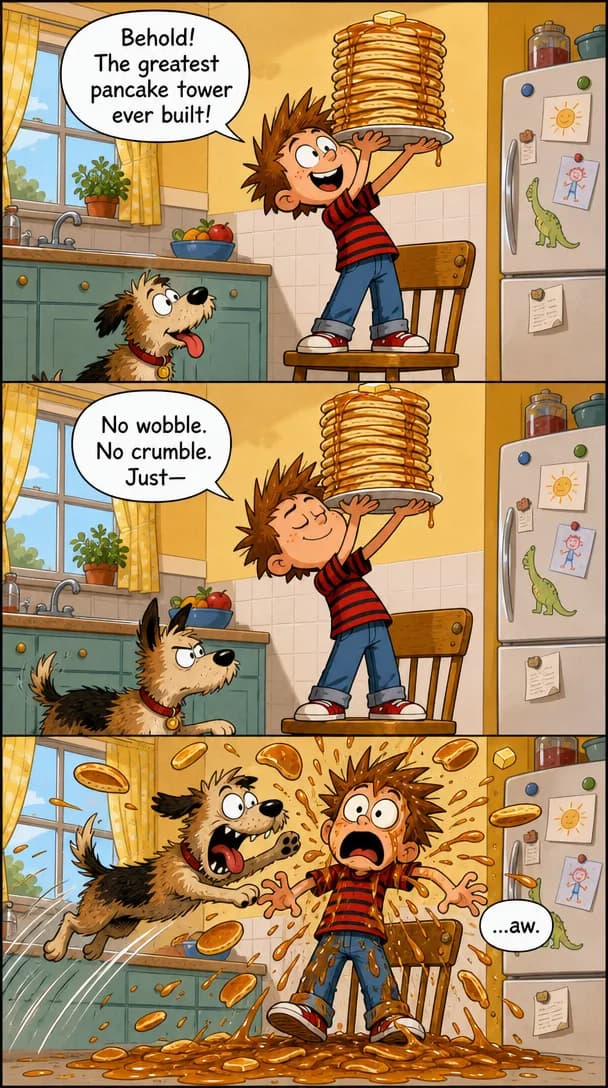
Start with our AI comic generator and pick Comedy as your discipline.
How to make a comedy comic on TaleAtelier
Five steps, ~20 minutes for a 3-panel gag strip or ~30 minutes for a 10-panel comedy Short.
- 1
Sign up (free account)
2-3 minCreate a free account. Save characters and drafts. Pick a plan when you're ready to generate — enough for two 3-panel gag strips or one 6-panel Sunday-style comic.
- 2
Pick the Comedy style
1 minComedy on TaleAtelier is bright palette + expressive exaggeration + timing-aware panel rhythm. For gag strips, generate 3-4 panels. For sitcom-style comics, generate 8-10.
- 3
Design your cast (locked)
3-5 minComedy runs on returning characters — the straight-man / funny-man dynamic. Upload references or describe. TaleAtelier locks distinctive silhouettes across every panel. Track up to 6 characters.
- 4
Write setup → build → punchline
3-5 minComedy needs structure. Classic 3-panel: setup / complication / punchline. 4-panel: setup / build / mislead / punchline. Long-form: sitcom beat structure. Write each panel as one beat.
- 5
Generate and refine
10-15 min for 10 panelsNano Banana Pro renders each panel. Comedy expression is the hardest AI category — regenerate expressive-face panels 2-3 times to get the timing right. The punchline panel matters most.
Comedy timing on the page
Panel comedy has been solved for a century. Bill Watterson, Charles Schulz, and Bill Waterson-inspired cartoonists all use the same five techniques. When you write for the Comedy style, lean on these:
| Technique | What it does | Example |
|---|---|---|
| Beat panel | Silent panel between setup and payoff. Gives the reader a moment to expect the joke. Bill Watterson uses this constantly in Calvin & Hobbes. | Panel 2 of a 3-panel strip: Calvin thinks; Hobbes says nothing. The pause IS the joke's runway. |
| Overreaction shot | One character's face fills the panel in cartoonish overreaction. Bug-eyes, jaw drop, sweat drops. | Peanuts uses this for Charlie Brown's headshake / Snoopy's dance. Manga uses chibi mode for the same effect. |
| Cutaway punchline | Punchline panel doesn't show the joke's subject — shows the reaction to it, or an unexpected different angle. | Setup: 'What did you do?' Panel 2: reaction of horrified spectator. Reader fills in the offscreen chaos. |
| Repetition + subversion | Same visual repeats across 2-3 panels then breaks on the last. The rule-of-three structure. | Three panels of the character walking normally; fourth panel walks into a lamppost. Classic slapstick. |
| Ending on the straight-man | Punchline lands on the reaction shot of the straight-man character, not the funny-character. Reader laughs at the reaction. | Garfield / Jon dynamic. The final panel is Jon's face, not Garfield's snark. |
Reference: Bill Watterson, The Complete Calvin and Hobbes (2005, Andrews McMeel); Charles Schulz interviews (Schulz Museum archive); Scott McCloud, Understanding Comics (1993). Verified .
Comedy comic formats — pick your form
Different comedy forms have different rhythms. Pick the format that fits your joke and platform:
| Format | Where it lives | Canonical | Structural tip |
|---|---|---|---|
| 3-panel strip | Newspaper daily; social media | Peanuts (Schulz), Calvin & Hobbes daily | Setup / complication / punchline. Tightest form. |
| 4-panel manga (yonkoma) | Japanese newspapers, manga magazines | Azumanga Daioh (Azuma 1999-2002); K-On! (Kakifly 2007-2010) | èµ·æ‰¿è»¢çµ (ki-shō-ten-ketsu): intro / build / twist / conclusion |
| Sunday-style page | Weekly newspaper; long-form web | Calvin & Hobbes Sundays, Bloom County (Breathed) | 6-9 panels with a bigger visual splash. More room for setup. |
| Webcomic long-form | Webtoon Canvas, Tapas, personal sites | xkcd, Sarah's Scribbles, The Oatmeal | Vertical scroll, variable panel count. Comedy through scroll pacing. |
| Sitcom-style comic | Long-form print, graphic novel comedy | Persepolis comedic scenes (Satrapi); Hark! A Vagrant (Beaton) | Cast + recurring beats + character-driven comedy. |
Chibi mode & exaggeration
Manga solved a comedy problem Western comics still wrestle with: how do you show a character's cartoonish overreaction without breaking realism? The manga answer is chibi mode — character temporarily becomes squat, big-headed, super-deformed. Reader accepts it as an emotional shortcut, not a rule change.
Chibi mode works on TaleAtelier across any style, but Comedy leans into it hardest. Ask for “chibi mode” on your punchline panel and Nano Banana Pro renders the character in chibi form for that panel only, returning to normal proportions next panel. The mode-switch itself is part of the joke.
Other manga-derived exaggerations that translate:
- • Sweat drops — visible on forehead, single or multiple. Shows anxiety or embarrassment.
- • Vein-pop mark — throbbing vein on temple. Shows anger, comically.
- • Nosebleed — used for embarrassed attraction (manga convention). Culturally specific.
- • Motion lines / speed lines — cartoonish flailing motion.
- • Facefault — character falls over comically at an absurd statement.
Comedy prompt patterns that work
3-panel setup (chibi mode)
'Panel 1 of 3' + chibi mode + specific reaction word (excited/surprised) gets you comedy-ready expressions. Bright palette signals gag comedy vs serious comic.
Beat / silent panel
Explicit 'silent beat panel' + 'no dialogue' + named canonical influence. Nano Banana Pro respects the deadpan when you name it.
Punchline overreaction
Overreaction is the comic-language finish. Sweat drops, motion lines, chibi exaggeration — the manga comedy vocabulary works here too.
When to reach for another tool (honest)
- Text-heavy webcomic (The Oatmeal, xkcd) → these comics live in text more than image. AI comic tools are strongest at visual-driven comedy. For text-heavy long-form, use a document editor + illustrations imported separately.
- Meme-style single-image comedy → Imgflip or basic meme tools are faster for one-shot memes.
- Multi-panel gag comic or long-form comedy → TaleAtelier. Multi-panel + character consistency + timing-aware pacing.
FAQ
Last reviewed:
Comedy style vs Comic Strip Maker — which do I use?+
The Comic Strip Maker tool is the workflow-focused page for 3-4 panel strips (any style). The Comedy style is the visual aesthetic — bright, expressive, exaggerated. You'd typically pick Comedy style AND use the Comic Strip Maker workflow if you're making gag strips. Comedy style also works for longer-form sitcom comics up to 20 panels.
Does TaleAtelier handle 3-panel gag strip pacing well?+
Yes — set panel count to 3 or 4 for classic newspaper-strip pacing. TaleAtelier splits your prompt into setup / complication / punchline structure automatically. Write each panel as one story beat and the pacing comes out clean. Comedy timing lives or dies on beat structure.
Can AI actually generate funny comics?+
Honestly, structural comedy (setup / build / punchline) — yes. Character-driven comedy (Charlie Brown's melancholy, Calvin's kid-logic) — much harder. AI can render expressive faces and timing panels, but genuine comedic writing still needs a human hand. Best use case: write your gag script yourself, use TaleAtelier for the visual delivery.
How does chibi mode work?+
Chibi is manga's shortcut for comedy — characters temporarily become squat, big-headed, exaggerated. In your prompt, ask for 'chibi mode' or 'super-deformed' on the punchline panel. TaleAtelier renders the character in chibi form for that panel only, then returns to normal proportions on the next. The visual mode-switch IS part of the joke.
Can I make Calvin & Hobbes-style comics?+
You can lean toward that aesthetic — bright palette, expressive line, beat-panel timing, kid-and-imaginary-friend dynamic. Name Bill Watterson or Calvin & Hobbes as a stylistic influence. But you can't reproduce Calvin, Hobbes, or the strip's characters legally — Watterson has famously never licensed them. Original characters in that tradition = fine.
How many comedy panels does each plan include?+
Starter ($9.99/mo, 2,000 coins) covers ~2-3 Short comics per month. Plus ($24.99/mo, 7,000 coins) suits regular publishing. Pro ($59.99/mo, 20,000 coins) is for studios and heavy users. All plans use the same character consistency.
What about webcomic-style comedy (xkcd, The Oatmeal)?+
TaleAtelier's Comedy style leans expressive-cartoonish. For xkcd-style stick-figure minimalism, you'd need to prompt very deliberately (minimal line, stick figures, no color) — it's not the default. Same for text-heavy long-form comedy (The Oatmeal) — that lives more in text than image. TaleAtelier is stronger on visual-driven comedy.
Ready to make people laugh?
Monthly plans from $9.99. Cancel anytime.
Create your account