AI Horror Comic Generator: Silent Panels, Recurring Monsters, True Dread
By the TaleAtelier Editorial Team — last reviewed
TL;DR
TaleAtelier makes horror comics with locked monster designs across every panel. Powered by Nano Banana Pro (Gemini 3 Pro Image, GA November 2026). 19 styles including Horror (Junji Ito-inspired ink), Noir, and Manga (Berserk-style grimdark). Monthly plans from $9.99. Verdict: best AI tool for horror sequential storytelling. For single scary images use Midjourney or NightCafe. AI-generated horror still doesn't reach the dread of Junji Ito's hand — silent panels help.
The style
One sample panel — the visual language of Horror rendered by TaleAtelier. Line weight, palette, and composition conventions all baked into the discipline.
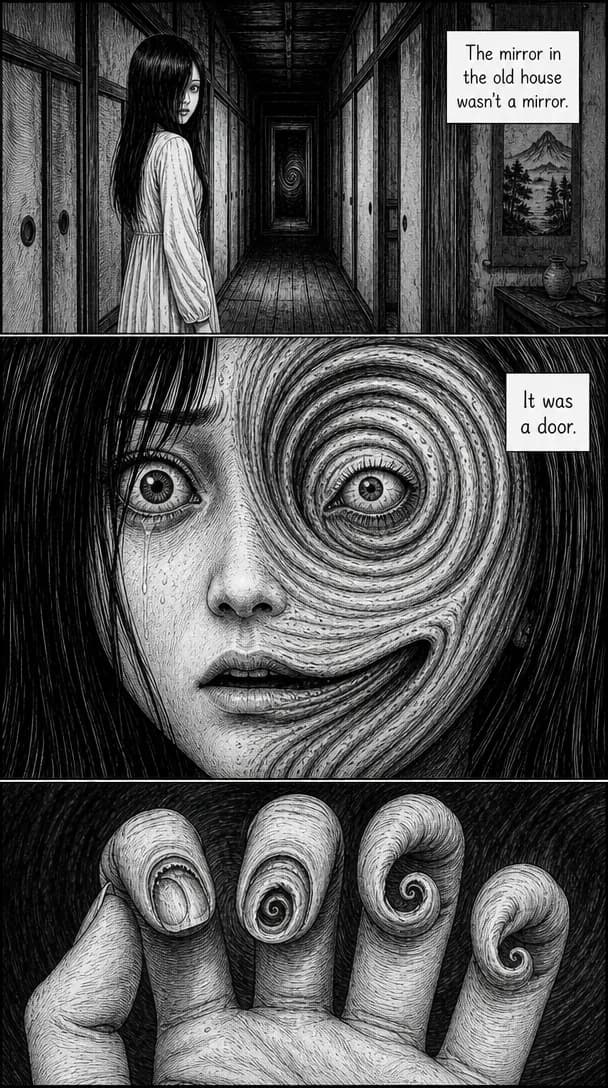
Start with our AI comic generator and pick Horror as your discipline.
How to make a horror comic on TaleAtelier
Five steps, ~30 minutes for a 10-panel horror Short.
- 1
Sign up (free account)
2-3 minCreate a free account. Save characters and drafts. Pick a plan when you're ready to generate — enough to test horror pacing on a Short comic.
- 2
Pick the Horror style
1 minHorror on TaleAtelier leans on Junji Ito-inspired ink work: heavy shadows, negative space, precise line variation. For grimdark horror (Berserk lineage) layer Manga style; for atmospheric noir-horror layer Noir style.
- 3
Design your protagonist and antagonist (locked)
3-5 minUpload references or describe both. Horror lives on the recurring monster — TaleAtelier stores a fingerprint per character so your creature stays consistent across every reveal. Track up to 6 characters.
- 4
Write the story with silent-panel markers
5-10 minPlot in 3-5 sentences per act. Mark the silent panels explicitly (before the monster reveal, after the impact). TaleAtelier respects panel-count structure — a 10-panel Short can hold 3 silent panels without losing story.
- 5
Generate and refine
10-20 min for 10 panelsNano Banana Pro renders each panel. Horror often needs iteration — the model can over-render monsters when subtlety would scare more. Regenerate individual panels with less spec if it goes too CGI-monster.
Horror comic craft — what makes fear work on the page
None of the top-ranking “AI horror comic” competitors teach the craft. They give you a filter, a random gallery, and hope for the best. Here's what actually makes a horror comic scary — pulled from Junji Ito, EC Comics, and Alan Moore:
| Technique | From | What it does | On TaleAtelier |
|---|---|---|---|
| Silent panels | EC Comics (Tales from the Crypt, 1950-1955); Junji Ito (Uzumaki, 1998-1999) | A panel with no dialogue and often no motion — just image. Reader supplies the dread. | Explicitly mark 'no dialogue, quiet reveal' in your brief. TaleAtelier honors it. |
| Off-panel monster reveal | Junji Ito; Alfred Hitchcock (film theory transferred to comics) | Show the reaction, not the monster. Reader's imagination fills in worse than any drawing. | Prompt: 'wide panel, character face frozen in horror, monster off-frame, only shadow visible'. |
| Setup-payoff over multiple panels | EC Comics; Alan Moore (Swamp Thing, 1984-1987) | Panel 1: normal scene. Panel 2: slight wrongness. Panel 3: the reveal. Timing kills the reader. | Write your brief as 3-beat sequences. Don't compress setup+payoff into one panel. |
| Negative space + heavy shadow | Junji Ito; Mike Mignola (Hellboy, 1993+) | Large black areas force the eye to the small terror. Contrast IS the horror. | Prompt keywords: 'heavy negative space, ink-heavy shadows, single light source'. |
| Body horror precision | Junji Ito; Kentaro Miura (Berserk, 1989-2021) | Wrongness in familiar anatomy scares more than alien monster. One extra joint, not tentacles. | Describe the small wrong detail specifically. Vague 'body horror' produces generic tentacles. |
Canonical: Uzumaki (Junji Ito, 1998-1999, Shogakukan); Tales from the Crypt (EC Comics, 1950-1955); Swamp Thing (Alan Moore run, 1984-1987, DC); Hellboy (Mike Mignola, 1993+, Dark Horse). Verified .
Where AI horror still fails (honest)
If we told you AI horror was as scary as Junji Ito, we'd be lying. Three real limitations you should know about:
- Over-rendering kills dread. AI models default to detail. A too-detailed monster stops being scary — the imagination has nothing to fill in. Human horror artists know when to leave things vague. Workaround: prompt for restraint (“partially obscured, only silhouette visible”).
- Monster consistency degrades on abstract creatures. Humanoid monsters and creatures with distinct silhouettes lock well. Shapeless entities (Junji Ito's spirals, Lovecraftian abstractions) drift more between panels. Workaround: describe the creature via specific features not overall shape.
- Safety filters can neuter dread. Nano Banana Pro has content guardrails. Explicit gore and heavy body horror can trigger softening. For psychological horror this rarely triggers; for splatter-horror it will.
Recurring monster consistency
A horror comic's recurring threat has to look the same each time it appears — otherwise the reader stops fearing it. TaleAtelier's character fingerprint approach applies to monsters and creatures too.
Consistency ceiling depends on silhouette specificity — the more distinctive the creature's shape, the better it locks.
See the character-consistency wedge worked in full on our photo-to-comic page, where the same character across multiple panels is the demonstration.
Horror prompt patterns that work
Silent reveal panel
Silent + wide + off-panel horror at the vanishing point. Nano Banana Pro respects 'no dialogue' explicitly.
Body-horror close-up
Specific wrongness (six fingers) beats generic 'body horror'. Named influence (Junji Ito) gives model the line-weight reference.
Setup panel (before the horror)
Horror needs the calm before. Explicit 'no visible threat' prevents the model from foreshadowing too hard.
When to reach for another tool (honest)
- Single scary image or one-off horror portrait → Midjourney V8.1 or NightCafe. One-shot single images are their strength.
- Photo-to-horror filter (turn selfie into scary version) → FlexClip and similar photo filters do this in one click. Not what we're for.
- Horror story text (no images) → Squibler or Quillbot handle horror prose. TaleAtelier is comics, not novels.
- Sequential horror comic with recurring monster → TaleAtelier. Character consistency + panel timing + craft-aware output.
FAQ
Last reviewed:
Can AI actually generate scary horror comics or does it come out cheesy?+
Honestly, it depends on your prompts. Vague prompts (scary monster, dark alley) get cheesy stock horror. Specific prompts using named influences (Junji Ito, EC Comics), specific techniques (silent panel, negative space), and specific wrongness (six fingers, not tentacles) get output that reads as horror. AI horror still doesn't reach the dread of the best human artists, but it beats cheesy when you write good prompts.
How does TaleAtelier keep a monster consistent across panels?+
Same character-fingerprint system we use for humans. Upload a reference (or describe in detail), and TaleAtelier stores facial structure / body proportions / distinctive features and passes them to Nano Banana Pro on every panel. Works well for humanoid monsters and creatures with distinctive silhouettes; struggles more on shapeless or heavily abstract creatures.
Why do silent panels matter in horror comics?+
Because dialogue rushes the reader past dread. A silent panel forces you to sit with the image. Junji Ito's Uzumaki (1998-1999, Shogakukan) uses long silent stretches — the reader supplies fear better than any caption could. On TaleAtelier, mark silent panels explicitly in your brief so the model doesn't try to fill them with sound effects.
Do safety filters ruin horror generation?+
Sometimes. Nano Banana Pro has safety guardrails that soften explicit gore. This is honestly a limitation for splatter-horror creators. For psychological horror and atmospheric dread (Junji Ito lineage), the filters rarely trigger. If you're making body-horror or gore-heavy work at scale, you may hit friction.
Can I make a Junji Ito style horror manga on TaleAtelier?+
Yes — pick Manga style + describe scenes with Junji Ito as a named influence. Nano Banana Pro understands the reference. You'll get precise line work and ink-heavy shadow that reads as Ito-inspired. Not identical to his actual hand — no AI is — but recognizably in the tradition.
How many horror panels can I make per month?+
Starter ($9.99/mo, 2,000 coins) covers ~2-3 Short comics per month. Plus ($24.99/mo, 7,000 coins) suits regular publishing. Pro ($59.99/mo, 20,000 coins) is for studios and heavy users. All plans use the same character consistency.
Should I do 'grimdark' via Horror style or Manga style?+
Berserk-style grimdark: use Manga style (matches Miura's ink-heavy monochrome line). Junji Ito psychological horror: Horror style. Atmospheric noir-horror (Hellboy lineage): Noir style with horror keywords. All three are valid depending on what you want.
Ready to make your horror comic?
Monthly plans from $9.99. Cancel anytime.
Create your account