AI Line Art Generator: Coloring Book & Tintin-Style Comics
By the TaleAtelier Editorial Team — last reviewed
TL;DR
TaleAtelier renders line art across all three generators — Comic Book (up to 400 pages, locked characters, 12+ languages), Preview (free cover + first page), and Portrait (single illustration from a photo). Pure black ink on pure white paper, thick outer contours, fine interior detail, zero fill. Best for coloring books, Tintin-style clean-line comics, tattoo reference portraits, and print projects meant to be colored by hand.
The style
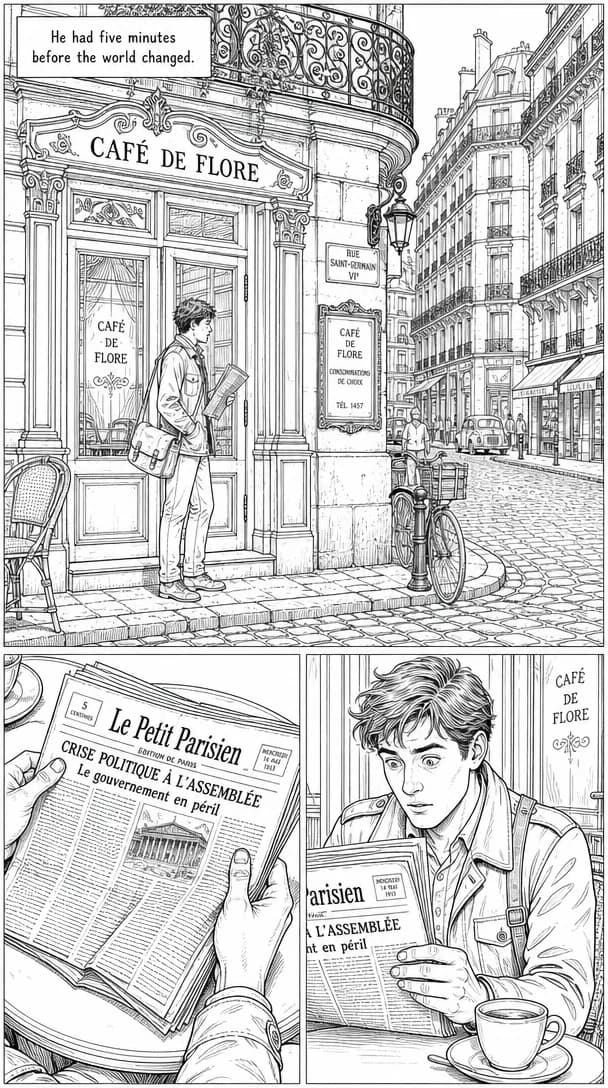
One sample rendered by TaleAtelier — pure black ink, thick outer contours, zero shading, every shape colorable.
Three ways to use line art on TaleAtelier
Line art is available across all three of our generators. Same style, three formats.
Line Art Comic Book
Full illustrated comic up to 400 pages in pure line-art style. Best for indie clean-line titles (Tintin lineage), coloring books that ship as PDFs, print projects meant to be colored by hand, and educational storybooks where a class or child adds color themselves. Custom title, 12+ output languages.
Start a line-art comic →Line Art Preview
Free cover + first page rendered in line art before you commit. See exactly how the ink treatment handles your characters and title. Upgrades in-place to the full book after checkout — no re-generation.
Try the free preview →Line Art Portrait
Single line-art illustration from your uploaded photo. Best for tattoo reference designs (bring to your artist), coloring-page gifts (personalized for a birthday), minimalist framed portraits, and merch with a clean-line aesthetic.
Make a line-art portrait →How to make line art on TaleAtelier
Five steps, roughly 30 minutes for a 10-panel comic Short. Portraits render in 2-3 minutes.
- 1
Sign up (free account)
2-3 minCreate a free account. Save characters and drafts. No credit card for the trial preview.
- 2
Pick the Line Art style
1 minAvailable across all three generators — Comic Book (up to 400 pages), Preview (free cover + first page), and Portrait (single stylized illustration).
- 3
Upload photos or describe your character
3-5 minFor portraits: one photo works. For comics: upload photos of up to 6 characters — TaleAtelier locks each face into a persona sheet so the line-art treatment stays consistent across every page.
- 4
Write the brief
5-10 minFor comics: 3-5 sentences per act plus your custom title. Line art shines for coloring books, Tintin-style clean-line action, tattoo reference designs, and print projects that will be colored elsewhere.
- 5
Generate and refine
10-20 min for 10 panelsTaleAtelier renders each panel with pure black ink on white paper, thick outer contours, fine interior detail, zero fill. Regenerate any panel where shading crept in or the lines got too thin to color inside.
What makes it look line-art
Line art has two traditions: European ligne claire (Tintin, Franco-Belgian comics) and printed coloring books. When you pick Line Art on TaleAtelier, we bake in the four features that separate real line art from "a filter that removed color":
- Pure black on pure white. No grayscale, no shading, no fill. Every pixel is either black ink or white paper. Zero exceptions.
- Thick outer contours. The outermost lines are noticeably heavier than interior lines. This is what makes the drawing read as line art rather than technical sketch.
- Fine interior detail. Inside the thick outer contours, interior lines are cleaner and thinner. Suggests form without shading.
- Every shape colorable. Every enclosed area of the drawing is a complete closed shape — meaning a kid can color inside without lines leaking. This is what makes line art work as a coloring book.
Line art prompt patterns that work
Coloring book page for a kid
'Coloring-book-ready' + 'zero shading' + 'thick outer contours' = actually usable for a kid to color inside. Regenerate if any grayscale creeps in.
Tintin-style clean-line action panel
'Ligne claire' is the French tradition Tintin comes from. Referring to it directly + 'no shadow' = the clean-line action-comic feel.
Tattoo reference portrait
Tattoo references need scalable clean lines. 'Deliberate line weight variation' + 'tattoo-reference styling' = the tattoo artist can trace or scale directly from this.
When to reach for another style
- You want the drawing shaded already → Pencil Sketch — grayscale with cross-hatched shadows, finished feel.
- You want color in the final output → any of our color styles (Cartoon, Watercolor, Anime).
- Newspaper-strip or halftone-shading feel → Comic Book — classic western ink with newsprint texture and halftone dot shading.
- Coloring book, Tintin-style clean-line comic, tattoo reference, print-and-color project → Line Art is exactly this. Zero fill is the feature, not a limitation.
FAQ
Last reviewed:
Line art vs pencil sketch — what's the difference?+
Line art is pure black on white with zero shading — meant to look finished as outlines, or ready to be colored in yourself. Pencil sketch is grayscale with visible directional strokes and cross-hatched shadows — the graphite does tonal work. Line art reads clean and finished-as-outline; pencil sketch reads hand-drawn and shaded.
Can I use line art output as a coloring book?+
Yes — that's one of its primary use cases. Export the pages as PDF from your TaleAtelier project, print them, and color them yourself or hand them to kids. The 'zero fill' rendering leaves every shape colorable.
Which generator is best for line-art tattoo reference?+
Portrait generator — single-image output at high resolution is what tattoo artists need. Upload your photo, get a clean line-art reference to bring to your tattoo appointment.
Can I get line art in the Preview generator?+
Yes — all 36 styles including Line Art are available in Preview. Free cover + first page before committing to the full book. Preview upgrades in-place, so nothing regenerates when you check out.
How does character consistency work with line art?+
Same as every other style. Upload a photo of each character, TaleAtelier locks the face into a persona sheet, then applies the line-art treatment consistently across every page. You can track up to 6 characters.
Line art vs comic-book style — which for a clean-line indie comic?+
Line art for pure zero-fill (Tintin, kids' coloring). Comic Book for classic western ink with halftone shading and newsprint texture (Sunday-strip lineage). Different traditions — line art is the ligne claire European tradition; comic-book is the American newsprint tradition.
Ready to make line art?
Free preview + monthly plans from $9.99. Cancel anytime.
Create your account