AI Fantasy Comic Generator: Locked Characters Across 400 Panels
By the TaleAtelier Editorial Team — last reviewed
TL;DR
TaleAtelier makes fantasy comics up to 400 panels with the same knight, mage, or dragon across every panel. Powered by Nano Banana Pro (Gemini 3 Pro Image, GA November 2026). Three fantasy modes: high fantasy (LOTR / Sandman), dark fantasy (Berserk-influenced), urban fantasy (Locke & Key). Monthly plans from $9.99. For a single fantasy portrait, use Midjourney V8.1. For fantasy stories with returning characters, this is the tool.
The style
One sample panel — the visual language of Fantasy rendered by TaleAtelier. Line weight, palette, and composition conventions all baked into the discipline.
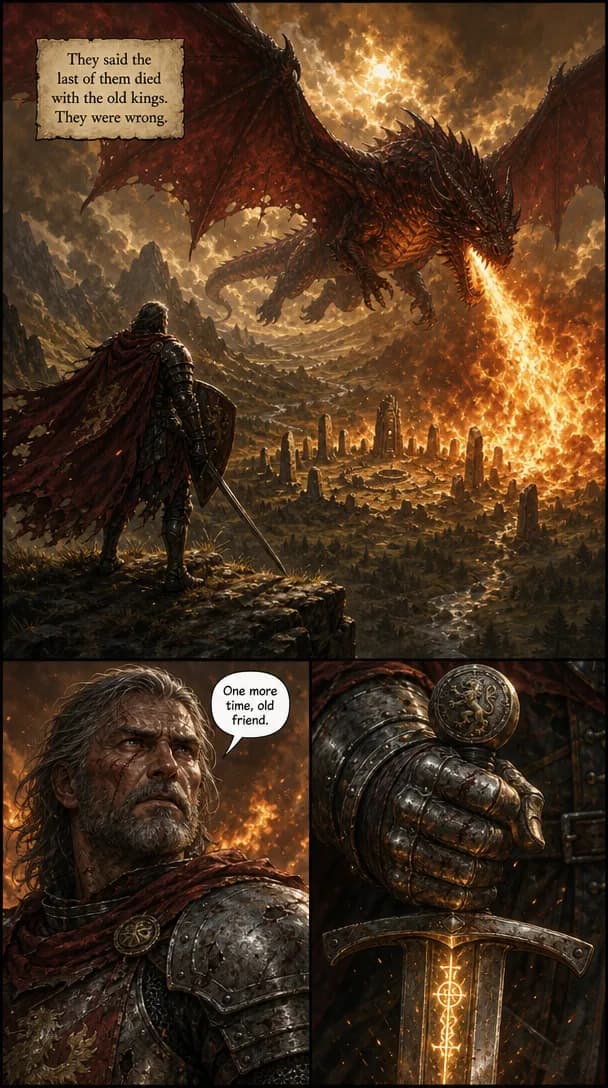
Start with our AI comic generator and pick Fantasy as your discipline.
How to make a fantasy comic on TaleAtelier
Five steps, ~30 minutes for a 10-panel Short comic.
- 1
Sign up (free account)
2-3 minCreate a free account. Save characters and drafts. Pick a plan when you're ready to generate — enough to test the Fantasy style with one main character.
- 2
Pick the Fantasy style
1 minFantasy is our high-fantasy painterly preset (LOTR / Sandman lineage). For grimdark Berserk-style, layer on Manga style; for urban fantasy, layer on Manhwa. All three are switchable per project, not per panel.
- 3
Design your protagonist (locked)
3-5 minUpload a photo or describe your knight, mage, ranger, or thief. TaleAtelier stores a character fingerprint and reuses it across every panel. You can track up to 6 characters — enough for a party.
- 4
Write the story arc
5-10 minPlot in 3-5 sentences per act. TaleAtelier splits into panels via story-beat structure. Fantasy arcs work best with clear setup (village) → journey → climax (encounter) → resolution.
- 5
Generate and refine
10-20 min for 10 panelsNano Banana Pro renders each panel. Regenerate individual panels for magic effects that miss (AI often over-literalizes fireballs; see the Magic section below).
High vs dark vs urban fantasy — visual conventions
Fantasy isn't one visual language. A LOTR-style epic looks nothing like a Berserk-style grimdark or a Constantine urban fantasy. Match the subgenre to the visual conventions:
| Subgenre | Lighting | Ink / line | Palette | Canonical works | TaleAtelier tip |
|---|---|---|---|---|---|
| High fantasy | Luminous, painterly, golden hour | Painterly, blended edges, minimal hard line | Rich amber, forest green, sky blue | Lord of the Rings, Wheel of Time | Fantasy style + soft lighting keywords |
| Dark fantasy | Low-key, high contrast, negative space | Ink-heavy, hatched shadows, sharp line weight variation | Desaturated, black, blood red, bone | Berserk (Kentaro Miura), Sandman (Neil Gaiman) | Manga style + dark fantasy keywords |
| Urban fantasy | Photoreal city + magic-effect overlay | Clean line, modern comic art | Naturalistic + magic-glow accent color | Locke & Key, Constantine (Hellblazer) | Manhwa style + urban fantasy keywords |
Canonical works: Berserk (Kentaro Miura, 1989-2021, Hakusensha); The Sandman (Neil Gaiman, 1989-1996, DC/Vertigo); Locke & Key (Joe Hill + Gabriel Rodríguez, 2008-2013, IDW). Verified .
Rendering magic and effects (the honest part)
This is where every AI comic tool struggles, us included. AI over-literalizes named spells — ask for a “fireball” and you get a CGI-style giant flame that doesn't read as a comic panel. Ask for “lightning bolt” and you get videogame VFX.
The fix is composition, not more prompt words. Good fantasy comics show magic through consequence and reaction, not literal spell rendering. Alan Moore's Promethea (1999-2005) shows magic mostly as symbol and light. Neil Gaiman's Sandman shows dream-magic through atmosphere, not fireballs. Even Kentaro Miura's Berserk shows most magic as environmental dread rather than explicit effect.
Working technique on TaleAtelier:
- • Silent panel + subtle glow at the caster's hand rather than full spell blast
- • Reaction panel on the target's face, not the spell itself
- • Environmental shift — dim light, hair movement, ground scorching — beats CGI VFX
- • Cut on impact — show the setup and the aftermath, let the reader fill the moment
This is a general AI-comic limitation, not TaleAtelier-specific.
Character consistency across a fantasy arc
Fantasy stories live or die on returning characters. If your wizard's beard changes shape between panels 3 and 7, the reader stops believing the world. TaleAtelier stores a character fingerprint per character and re-injects it on every panel generation.
Works reliably for faces, hair, and main outfit. Drifts on subtle details (specific rune patterns, gemstone shapes on jewelry).
See the character-consistency wedge worked in full on our photo-to-comic page, where the same character across multiple panels is the demonstration.
Fantasy prompt patterns that work
Establishing shot (high fantasy)
Specific place-name + specific time-of-day + specific palette. AI struggles with 'fantasy village' but nails 'Elarion at golden hour, warm amber'.
Character close-up (dark fantasy)
Named canonical influence (Berserk) works — Nano Banana Pro understands the visual reference. Avoid 'dark and gritty' — that's vague.
Magic effect (silent panel)
AI over-literalizes spells (giant fireballs). Silent panels with subtle magic hints work far better than 'cast a huge fireball spell'.
When to reach for another tool (honest)
- Single fantasy portrait or character sheet → Midjourney V8.1 is the best-in-class for single fantasy images. If you just want one dragon or one hero shot, use Midjourney and don't overpay for a comic tool.
- D&D character portrait for your character sheet → Midjourney or Adobe Firefly. One-shot single-image job — not what we're built for.
- Fantasy world maps → Inkarnate is purpose-built. TaleAtelier does sequential art, not cartography.
- Fantasy story with returning characters → TaleAtelier. Multi-panel + character consistency is what we do.
FAQ
Last reviewed:
Is this an AI fantasy character generator or a fantasy comic generator?+
Comic. For a single fantasy portrait (character sheet, D&D avatar, one hero shot), use Midjourney V8.1 (default since June 11, 2026) or Adobe Firefly — both are faster for single images. TaleAtelier is built for fantasy stories with returning characters across multiple panels.
Can TaleAtelier keep the same knight or wizard consistent across 20+ panels?+
Yes. Character fingerprints (facial structure, proportions, armor, hair) are stored per character and passed to Nano Banana Pro on every panel. Face + main outfit stays consistent across 20+ panels. Subtle details (specific rune patterns, gemstone shapes on jewelry) drift more.
How do I get dark fantasy or grimdark Berserk-style output?+
Pick Manga style (for the ink-heavy line weight) and describe your scene with Berserk or Sandman as a named influence — Nano Banana Pro understands both canonical works. Add keywords: high contrast, negative space, low-key lighting, ink hatching.
Why does AI fail on named magic spells (fireball, lightning bolt)?+
Two reasons: (1) AI over-literalizes and gives you a giant CGI fireball that doesn't read as a comic panel; (2) magic effect language is genre-inconsistent — a 'fireball' in Dragon Age looks nothing like one in D&D. Workaround: describe the *visual* not the spell. 'Faint blue arcane glow at fingertips' beats 'cast a lightning bolt spell'.
How many fantasy panels does each plan include?+
Starter ($9.99/mo, 2,000 coins) covers ~2-3 Short comics per month. Plus ($24.99/mo, 7,000 coins) suits regular publishing. Pro ($59.99/mo, 20,000 coins) is for studios and heavy users. All plans use the same character consistency.
Can I do a party of 4 adventurers with 4 different characters?+
Yes. TaleAtelier tracks up to 6 characters. Ranger, mage, tank, rogue — all four get consistent fingerprints across every panel they appear in.
What about maps, worldbuilding artifacts, and lore documents?+
Not our thing. For fantasy world maps, use Inkarnate or Wonderdraft. For lore documents, use a text editor. TaleAtelier is for the sequential-art part of your world.
Ready to make your fantasy comic?
Monthly plans from $9.99. Cancel anytime.
Create your account