AI Seinen Style: Mature Manga with Cinematic Ink
By the TaleAtelier Editorial Team — last reviewed
TL;DR
TaleAtelier makes seinen-style comics: dense ink linework, cinematic framing, morally complex characters. In the tradition of Berserk, Vagabond, and Monster. Locked characters across up to 400 panels. 19 art styles including Manga, Manhwa, and Noir. Monthly plans from $9.99. Have a photo? Turn it into a seinen panel featuring you →
The style
One sample panel — the visual language of Seinen rendered by TaleAtelier. Ink density, cinematic framing, and character weight all baked into the discipline.
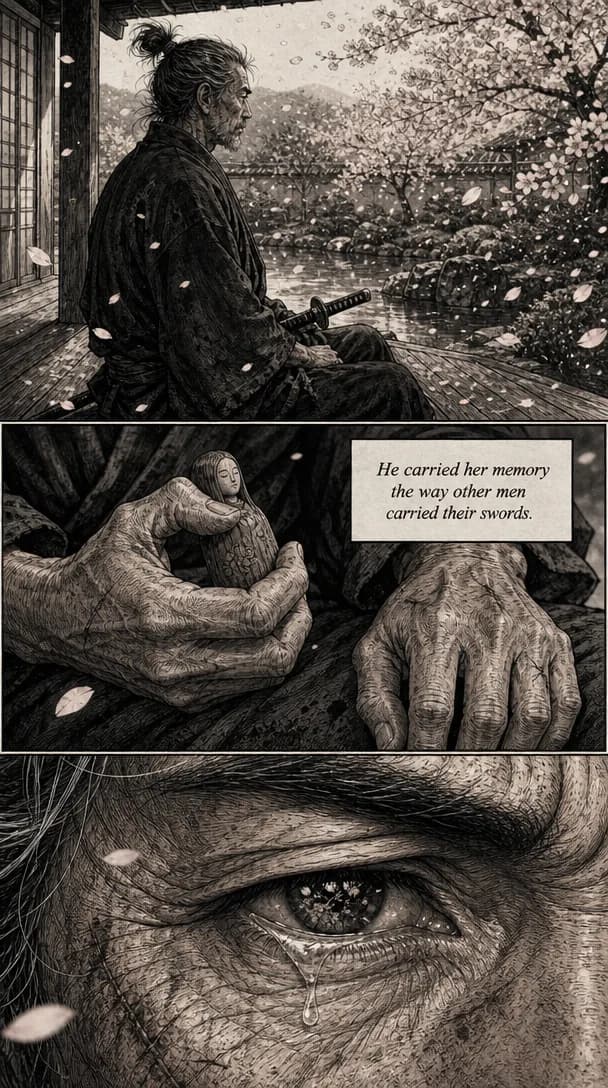
Start with our AI manga generator and pick Seinen as your discipline. Or use the general AI comic generator and select Seinen from the twelve visual disciplines.
How to make a seinen manga on TaleAtelier
Five steps, ~30 minutes for a 10-panel Short seinen.
- 1
Sign up (free account)
2-3 minCreate a free account. Save characters and drafts. Pick a plan when you're ready to generate — enough to test the Seinen style on a Short comic.
- 2
Pick the Seinen style
1 minSeinen on TaleAtelier is dense monochrome linework + cinematic framing + mature-themed composition. Different from Shonen (dynamic action lines, cleaner faces) and standard Manga (screentone-heavy, all-ages framing).
- 3
Design your protagonist (locked)
3-5 minUpload a photo or describe. TaleAtelier stores a character fingerprint and reuses it across every panel. Seinen protagonists usually carry visible scars, weathered clothing, and morally complex expressions — describe accordingly.
- 4
Write the story arc
5-10 minSeinen story arcs favor moral ambiguity over clean heroism. Setup → doubt → consequence → recontextualization. Think Berserk's Golden Age arc, not a Weekly Jump tournament. Panel rhythm skews slower with more silent beats.
- 5
Generate and refine
10-20 min for 10 panelsNano Banana Pro renders each panel with heavy ink, cross-hatch shadow, and cinematic framing. Regenerate individual panels that lose the seinen ink density or trend toward cleaner shonen linework.
What makes seinen look seinen
Seinen developed as a mature-audience counterpart to shonen — same monochrome-with-screentones base but heavier ink, slower pacing, and adult narrative register. When you pick Seinen on TaleAtelier, we bake in:
| Convention | What it is | Origin |
|---|---|---|
| Dense linework | Heavy ink density, cross-hatched shadows, detailed backgrounds. Every panel takes more time — this is intentional. Reader lingers longer per page. | Kentaro Miura's Berserk (1989+); Takehiko Inoue's Vagabond (1998+) |
| Cinematic framing | Wide establishing shots, extreme close-ups, low-angle heroic shots. More filmic than the standard grid manga uses. Panels often break borders. | Katsuhiro Otomo's Akira (1982-1990) brought cinematic composition into mainstream manga |
| Morally complex characters | Protagonists aren't clean heroes. Antagonists have coherent worldviews. Faces render as weathered, expressive, imperfect — not the polished shonen aesthetic. | Naoki Urasawa's Monster (1994-2001); Berserk's Guts and Griffith |
| Slower panel rhythm | More silent panels. Longer establishing sequences. Emotional beats get 3-4 panels instead of a single reaction shot. Reader pace is deliberate. | Yoshihiro Tatsumi's gekiga movement (1957+); Inoue's Real (1999+) |
| Mature subject matter | Violence, philosophy, adult relationships, historical realism, psychological complexity. Aimed at 18-40 year old readers, not the shonen (13-18) demographic. | Publisher demographic definitions — seinen literally means 'young man' (青年); marketed to men 18+ |
Reference: Frederik L. Schodt, Manga! Manga! The World of Japanese Comics (1983, Kodansha International); Paul Gravett, Manga: Sixty Years of Japanese Comics (2004). Verified .
Seinen vs shonen — the honest distinction
Shonen (少年) and seinen (青年) are Japanese publisher demographic labels — literally “youth” and “young man.” Shonen manga is marketed to boys and teens (Naruto, One Piece, Demon Slayer); seinen is marketed to men 18-40 (Berserk, Vagabond, Vinland Saga).
The visual language differs accordingly. Shonen leans toward clean line weight, dynamic action framing, exaggerated expressions, and clear hero-vs-villain composition. Seinen leans toward dense ink, cinematic framing, weathered character faces, and morally ambiguous composition. Same monochrome base — different emotional register.
On TaleAtelier, this is the choice between the general Manga preset (which defaults to a shonen-adjacent look) and the dedicated Seinen preset (which bakes in denser ink and cinematic framing). If your reference material is Miura, Inoue, Urasawa, or Otomo — pick Seinen.
Dense linework — the seinen ink tradition
Seinen ink density is the single most recognizable visual signature of the genre. Where shonen artists use screentones for shadow, seinen artists more often use hand cross-hatched ink — every shadow is drawn line-by-line rather than applied as a tone sheet.
- • Cross-hatch shadow: parallel and crossed line patterns for depth. Used heavily by Miura (Berserk) and Otomo (Akira).
- • Weathered texture: ink stipple on skin, clothing wear, armor scratches. Character surfaces show history.
- • Ink-heavy silhouettes: foreground figures often rendered as solid black shapes against detailed backgrounds. Compositional weight.
- • Detailed backgrounds: unlike shonen's frequent empty or screentoned backgrounds, seinen backgrounds are drawn with the same detail as characters.
- • Brush ink (Inoue tradition): Vagabond and Real use brush rather than pen, producing painterly line variation. TaleAtelier reaches this look with “brush ink” and “sumi-e” keywords.
On TaleAtelier, name the ink technique explicitly (“cross-hatch shadow,” “brush ink,” “ink-heavy silhouette”) and Nano Banana Pro renders proper seinen density. Vague “shadow” produces shonen-clean output.
Seinen prompt patterns that work
Vague prompts (“seinen panel”) produce generic manga output. Specific prompts (named ink techniques, named influences, cinematic angle callouts) produce output you actually want.
Cinematic establishing shot (Vagabond style)
Named canonical influence (Vagabond) + cinematic angle callout + explicit ink-density and cross-hatch keywords. Nano Banana Pro reaches the seinen density Vagabond is known for.
Morally weighted close-up (Berserk style)
Named character (Guts) locks the model to Berserk-lineage rendering. 'Morally complex' keyword helps model avoid clean-shonen face defaults.
Silent beat (gekiga tradition)
Explicit 'no dialogue' + 'silent panel' + gekiga reference produce the slower emotional pacing seinen is known for. Vague prompts default to shonen-speed panels.
When to reach for another tool (honest)
- Professional print-ready seinen → Clip Studio Paint is the industry standard for hand-drawn manga with pixel-perfect ink control. If you can draw, use it. TaleAtelier is for creators who can't or don't want to draw at that level.
- Brush-ink painterly work (Vagabond level) → nothing digital fully replicates Takehiko Inoue's brush ink. TaleAtelier gets close for a story with returning characters; a dedicated brush artist gets closer for one-off illustration.
- Seinen story with returning characters → TaleAtelier. Multi-panel + character consistency + proper cross-hatch density is exactly what we do.
FAQ
Last reviewed:
Seinen vs shonen on TaleAtelier — what's the difference?+
Shonen = clean lines, dynamic action framing, teen-hero protagonists (Naruto, One Piece). Seinen = dense linework, cinematic framing, morally complex adult protagonists (Berserk, Vagabond). Same monochrome base, different emotional register. Pick Seinen if your references are Miura, Inoue, Urasawa, or Otomo. Pick Shonen if your references are Kishimoto, Oda, or Toriyama.
Can TaleAtelier do Berserk-style grimdark seinen?+
Yes — pick Seinen style and describe scenes with Kentaro Miura or Berserk as a named influence. Nano Banana Pro understands the reference and produces heavy cross-hatch shadow, dense ink linework, and appropriately weathered character faces. Not identical to Miura's hand (nothing is), but visually in the Berserk tradition.
What about Vagabond's brush-and-ink painterly seinen?+
Also supported. Describe scenes with Takehiko Inoue or Vagabond as a named influence and emphasize 'brush ink' and 'sumi-e-influenced' in your prompt. The output leans toward the more painterly, less cross-hatched wing of seinen. Best for historical or contemplative stories.
Is seinen just 'adult manga'?+
Not quite. Seinen (青年) literally means 'young man' — it's a Japanese publisher demographic label for magazines aimed at men roughly 18-40. That correlates with mature themes but the term refers to the audience, not the content. A seinen manga can be philosophical (Monster), sports (Real), historical (Vagabond), or action (Berserk). What unifies them is a more adult narrative register than shonen.
How many seinen panels does each plan include?+
Starter ($9.99/mo) includes 2,000 coins — roughly 2-3 Short comics or 1 Medium comic per month. Plus ($24.99/mo) is 7,000 coins for regular publishing. Pro ($59.99/mo) is 20,000 coins for studios or heavy users.
Does seinen have to be violent?+
No. Seinen refers to the target audience, not the content. Naoki Urasawa's Monster is seinen but its violence is largely off-panel. Takehiko Inoue's Real is a seinen manga about wheelchair basketball with almost no violence. Slice-of-life seinen exists (Solanin, Oyasumi Punpun). The unifying quality is emotional and narrative maturity, not action.
Can I write josei on TaleAtelier if I want the adult-woman equivalent?+
Josei is the demographic label for adult women (Nana, Chihayafuru, Princess Jellyfish). TaleAtelier doesn't have a dedicated Josei preset yet — describe scenes with Ai Yazawa or Sumito Oowara as an influence within the Manga or Romance style, and you'll get close. For explicitly seinen (male-audience) work, use this Seinen style.
Ready to make your seinen?
Monthly plans from $9.99. Cancel anytime.
Create your account