AI Manhua Style: Chinese Full-Color Comics Generator
By the TaleAtelier Editorial Team — last reviewed
TL;DR
TaleAtelier makes manhua-style comics: full-color Chinese webcomic aesthetic, cultivation and xianxia visual language, ornate costume detail. In the tradition of Battle Through the Heavens, The King's Avatar, and Doupo Cangqiong. Locked characters across up to 400 panels. 19 art styles including Manga, Manhwa, and Seinen. Monthly plans from $9.99. Have a photo? Turn it into a manhua panel featuring you →
Not sure what separates manhua from manga or manhwa? See our full three-way comparison guide — etymology, differences, reading direction.
The style
One sample panel — the visual language of Manhua rendered by TaleAtelier. Vivid color, ornate detail, and cultivation-tradition composition all baked into the discipline.
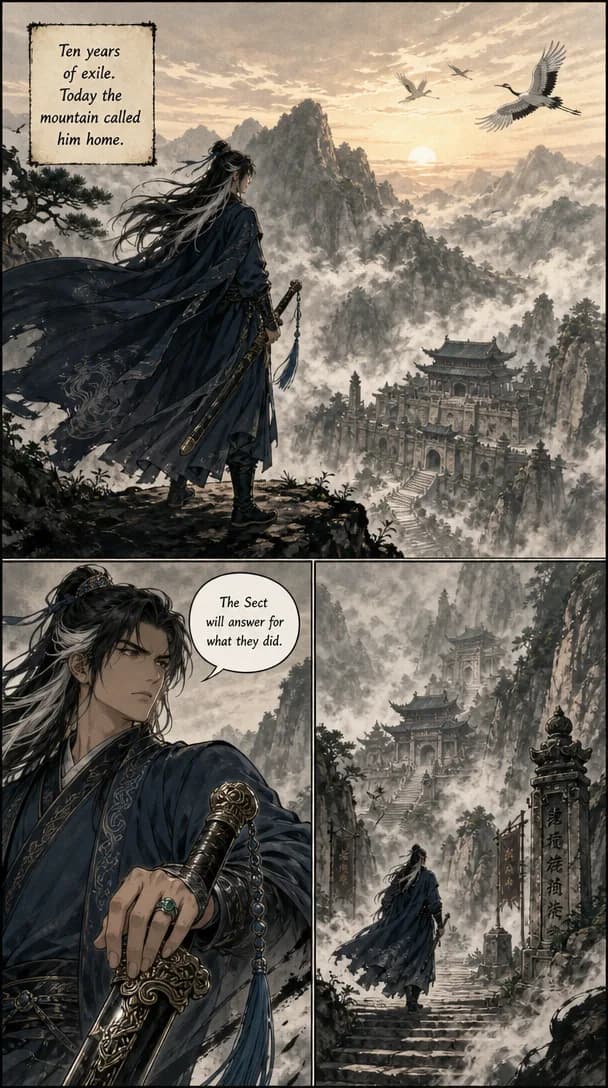
Start with our AI comic generator and pick Manhua from the twelve visual disciplines. For vertical-scroll format specifically, see the complete webtoon-creation guide.
How to make a manhua on TaleAtelier
Five steps, ~30 minutes for a 10-panel Short manhua.
- 1
Sign up (free account)
2-3 minCreate a free account. Save characters and drafts. Pick a plan when you're ready to generate — enough to test the Manhua style on a Short comic.
- 2
Pick the Manhua style
1 minManhua on TaleAtelier is full-color Chinese webcomic aesthetic: vivid palette, cultivation/xianxia visual language, ornate costume detail. Different from Manga (monochrome + screentones) and Manhwa (Korean vertical webtoon with cinematic lighting).
- 3
Design your protagonist (locked)
3-5 minUpload a photo or describe. TaleAtelier stores a character fingerprint and reuses it across every panel. Manhua protagonists frequently have long flowing hair, elaborate robes (hanfu, taoist robes), and jade or spirit-stone accessories — describe accordingly if you want the xianxia look.
- 4
Write the story arc
5-10 minManhua story arcs often follow cultivation progression: mortal → foundation → core formation → nascent soul (loosely modeled after xianxia novels). Setup → training → breakthrough → confrontation. Panel rhythm alternates ornate wide shots with dynamic power-technique reveals.
- 5
Generate and refine
10-20 min for 10 panelsNano Banana Pro renders each panel with vivid color, ornate costume detail, and appropriate elemental effect work (spiritual energy, sword aura, dao patterns). Regenerate individual panels that lose the color saturation or ornate detail.
What makes manhua look manhua
Manhua developed digitally in the 2010s on Chinese platforms (Kuaikan, Bilibili Manhua, Tencent Comics), free from Japan's print-monochrome constraint. When you pick Manhua on TaleAtelier, we bake in:
| Convention | What it is | Origin |
|---|---|---|
| Full-color palette | Vivid saturated color throughout — unlike Japanese manga's monochrome tradition. Sky blues, jade greens, robe reds, gold accents. Digital-native from the start. | Chinese webcomic platforms (Kuaikan, Bilibili Manhua, Tencent Comics, 2010s+) |
| Ornate costume detail | Hanfu robes, taoist ritual clothing, elaborate hairpieces, jade accessories, embroidered patterns. Character costumes carry cultural and status meaning. | Historical Chinese fashion (Tang, Song, Ming dynasties) filtered through wuxia and xianxia literature |
| Cultivation and xianxia visual language | Spiritual energy effects (qi flow, sword aura), dao patterns, elemental techniques (fire, ice, wood, metal, water). Visual shorthand for supernatural power. | Xianxia novel tradition (Xiao Ding, I Shall Seal the Heavens; Er Gen, Coiling Dragon); popularized in manhua by Battle Through the Heavens (2012) |
| Vertical scroll or page format | Chinese platforms support both — Kuaikan defaults to vertical scroll (like manhwa), Bilibili Manhua and Tencent Comics offer both. Format choice is yours. | Platform diversity — Chinese digital-first comics never fully committed to a single format the way Japan committed to page or Korea committed to scroll |
| Character archetypes | The talented young protagonist, the mysterious master, the arrogant rival sect, the pill-and-artifact merchant. Archetypes recur across manhua the way shonen archetypes recur. | Xianxia literary tradition; Journey to the West (16th century) is the ancestral text for the mentor-and-disciple archetype |
Reference: Wendy Siuyi Wong, Hong Kong Comics: A History of Manhua (2002, Princeton Architectural Press). Verified .
Manhua vs manhwa vs manga — the honest distinction
These three words all mean “comic” in their respective languages — Chinese, Korean, and Japanese. In English they refer to comics from those origins with their distinct visual traditions.
- • Manhua (漫画): Chinese comics. Usually full-color, often xianxia/cultivation themes, page or vertical-scroll format. Digital-native tradition from the 2010s.
- • Manhwa (만화): Korean comics. Usually vertical-scroll webtoons, full-color, cinematic lighting. Solo Leveling, Tower of God, Lore Olympus are the international breakouts.
- • Manga (漫画): Japanese comics. Usually monochrome with screentones, right-to-left page format, print-tradition first. One Piece, Berserk, Attack on Titan.
All three characters (漫画 / 만화 / 漫画) share the same Chinese root (漫画, meaning “impromptu sketches”) but the traditions diverged substantially over the 20th century. On TaleAtelier, they're distinct style presets — pick the one that matches your reference material and your intended audience.
Cultivation and xianxia — the manhua power system
Xianxia (仙侠, “immortal heroes”) is the fantasy genre most associated with international manhua. Protagonists progress through cultivation stages — mortal, foundation establishment, core formation, nascent soul, and beyond — gaining spiritual power at each breakthrough. The visual language is highly codified:
- • Qi (气): spiritual energy, rendered as glowing aura around body during technique use. Color varies by cultivation path (blue for water, gold for fire, green for wood).
- • Dao patterns (道纹): geometric symbols floating in air during power reveals. Represent metaphysical laws the cultivator has grasped.
- • Sword aura (剑气): visible energy trail from a spirit sword. Length and color signal cultivation stage.
- • Breakthrough scenes: world-shaking events when a cultivator advances a stage. Sky splits, elemental phenomena, ambient qi condenses. Manhua treats these as major spectacle moments.
- • Spirit stones and pills: ornate cultivation resources. Frequently detailed with care in manhua panels.
Not every manhua is xianxia — modern romance, historical wuxia (martial arts without cultivation), and school slice-of-life all exist. But xianxia is the internationally recognizable manhua aesthetic. Name it explicitly when you want it.
Manhua prompt patterns that work
Vague prompts (“manhua panel”) produce generic full-color anime output. Specific prompts (named cultivation keywords, named influences, explicit costume detail) produce output you actually want.
Cultivation breakthrough (xianxia hero shot)
Named canonical influence (Battle Through the Heavens) + explicit cultivation keywords (qi, dao patterns, breakthrough) reach the xianxia visual language. Nano Banana Pro handles the ornate detail well.
Sect ritual establishing shot
Named architecture (pagoda, dragon motifs) + establishing-shot framing produces the sweeping manhua sect visuals. 'Painterly color palette' anchors the softer coloring style common in manhua.
Slice-of-life modern manhua
Explicit 'modern' + 'not hanfu' keeps the model from defaulting to xianxia. Manhua covers modern-day stories too — just less famous internationally than the cultivation genre.
When to reach for another tool (honest)
- Chinese-language publication on Kuaikan or Bilibili → those platforms have their own author tools and expect specific format specs. TaleAtelier generates the panels; you handle the platform upload separately.
- Historically accurate hanfu illustration → for archaeological accuracy, work with a Chinese fashion historian or reference specialized hanfu-community resources. TaleAtelier renders stylized manhua-tradition costumes.
- Manhua story with returning characters and cultivation progression → TaleAtelier. Multi-panel + character consistency + proper xianxia visual language is exactly what we do.
FAQ
Last reviewed:
Manhua vs manhwa vs manga — what's the difference?+
Manhua = Chinese comics (full color, cultivation/xianxia often, page or scroll format). Manhwa = Korean comics (usually vertical-scroll webtoon, full color, cinematic lighting). Manga = Japanese comics (usually monochrome with screentones, right-to-left page format). All three are related traditions but visually distinct. Pick Manhua if your references are Chinese webcomics like Battle Through the Heavens, The King's Avatar, or Doupo Cangqiong.
Can TaleAtelier do proper xianxia manhua with qi effects?+
Yes — pick Manhua style and describe scenes with explicit cultivation keywords (qi, dao patterns, breakthrough, spirit stones, sword aura). Nano Banana Pro understands the visual language and renders the glowing energy effects, dao patterns in the air, and elemental techniques the genre is known for. Name a specific manhua (Battle Through the Heavens, Renegade Immortal) as an influence for stronger genre lock.
What about modern-day (non-xianxia) manhua?+
Absolutely supported. Explicitly write “modern” and describe contemporary setting details (schools, cities, casual clothing). Modern manhua like Fights Break Sphere spin-offs, romance manhua, and slice-of-life work all fit. Without explicit modern keywords, the model may default to cultivation robes because that's the international-famous manhua aesthetic.
Do manhua use vertical scroll like manhwa?+
Some do, some don't. Chinese platforms are more format-flexible than Korean ones — Kuaikan defaults to vertical scroll, Bilibili Manhua and Tencent Comics offer both scroll and page format. TaleAtelier generates both — pick page-format for a print-adjacent look or vertical-scroll for mobile-first webtoon-style output.
How many manhua panels does each plan include?+
Starter ($9.99/mo) includes 2,000 coins — roughly 2-3 Short comics or 1 Medium comic per month. Plus ($24.99/mo) is 7,000 coins for regular publishing. Pro ($59.99/mo) is 20,000 coins for studios or heavy users.
Are the character costumes historically accurate?+
TaleAtelier produces stylized manhua-tradition costumes, not archaeologically accurate historical fashion. Hanfu, taoist robes, and cultivator outfits are rendered in their popularized manhua form — which itself is stylized from historical Tang/Song/Ming fashion filtered through 40 years of xianxia literature and film. For historical accuracy, cross-reference with dedicated Chinese fashion historians.
Can I do wuxia (martial arts) instead of xianxia (cultivation)?+
Yes — wuxia is a related but distinct genre focused on martial artists rather than immortal cultivators. Describe scenes with wuxia keywords (martial arts, jianghu, sword fighting, no spiritual energy) and reference Jin Yong or Gu Long as influences. The Manhua style renders both, but wuxia will look more grounded and less supernatural than xianxia.
Ready to make your manhua?
Monthly plans from $9.99. Cancel anytime.
Create your account